Showing posts with label Rosarito Mayor. Show all posts

Friday, March 19, 2010

Rosarito Commends 3 Women For Work On ‘Baja Blondes’ Reality TV Program


By Ron Raposa


ROSARITO BEACH, BAJA CALIFORNIA , MEXICO ---The city has recognized three women for their work on developing a reality TV show that highlights the beauty, attractions and advantages of living in Baja California.


City Mayor Hugo Torres on Wednesday presented a plaque to Susanna Stehr, Debbie Shine and Robin Mackenzie, the trio of U.S. women who comprise the Baja Blondes.


Ms. Stehr lives in Rosarito where she owns a restaurant, Ms. Shine is an interior designer living here and Ms. Mackenzie is a writer/producer who lives both in the United States and Baja.


The three have produced a pilot for a reality TV series they hope will be broadcast in the U.S. It shows the beauty, comfort and relaxing pace of life in Baja. The series would feature fascinating regional people and places, as well as highlight the personalities of the women.

With media coverage focusing largely on Mexico ’s crackdown on drug cartels many people in the U.S. have lost sight of the fact that Baja is a wonderful. safe and welcoming place to visit and live, Ms. Stehr said.


Mayor Torres said the Baja Blondes are excellent ambassadors for Rosarito and the region because they show the actual lives of U.S. women living and working here, which gives what they say added credibility.


Those who gathered in the mayor’s office for the presentation. including city council members and other officials, also were shown a video clip of a recent Channel 5 San Diego interview which featured the Baja Blondes.

 (Photo shows, from left, Debbie Shine, Susanna Stehr, Rosarito Mayor Hugo Torres and Robin Mackenzie,)

Thursday, March 4, 2010

Rosarito 2009 Crime Rate Falls 21% To A Baja California Best 5-Year Low

By Ron Raposa


ROSARITO BEACH, BAJA CALIFORNIA, MEXICO---For 2009 Rosarito had the largest year-to-year decline in crime of any city in Baja California --- 21 percent --- and was the only city to reach a five-year low, according to state figures.


“These are very encouraging figures for Rosarito, especially in difficult economic times, when crime historically increases,” said Mayor Hugo Torres.


Calling the fight against crime a lifelong challenge for any city, Torres, who ran in 2007 on a platform of public security, said strong efforts will continue this year to reduce crime.


Those efforts, he said, will include increased policing in certain areas, more emphasis on neighborhood watch and private security, plus sports and other programs to keep city youth from delinquency and drug use.


Baja Gov. Jose Guadalupe Osuna Millan told the San Diego Union that Rosarito’s reduction in crime was one of Baja California’s success stories.


Overall, Baja California crime declined by an average of 10 percent in 2009 from 2008 and was lower than the level of the previous two years. The state’s rate was the same as 2006 and higher only than 2005.


Rosarito led all Baja cities in major categories for 2009, recording a 24 percent year-to-year decline in robbery and burglaries, 38 percent in violent crimes and 56 percent in murders, from 61 to 27, according to the Baja state figures.


Five of the killings were between members of rival drug cartels as the government makes it more difficult for them to operate, and three were of police officers.


Torres said that the drug-related killings are very troubling but even with them Rosarito has a lower homicide rate than many U.S. cities, including New Orleans, St. Louis and Baltimore, and Washington, D.C. (Based on FBI figures for 2008, the latest published)


“Understandably, much of the media coverage in the U.S. has focused on the crackdown on organized crime --- it’s a vital international issue,” he said. “But that has helped create a misleading impression about security here.”


Since taking office, Torres has led efforts to replace more than half of the city’s police force while expanding its size from about 150 to 230 officers.


He also established a special tourist police force that uses bilingual traffic tickets that can be mailed in from the U.S., an ombudsman office and a city department for visitor assistance.


The mayor also brought in former Army Capt. Jorge Montero to lead the police department as director of public security. He has praised his work as well as the support of the City Council


Torres also cited federal and state support plus a close working relationship with the Rosarito office of the state attorney general, which is responsible for most reporting and investigation of crime.


“Prevention is the key to crime reduction,” said Torres, who added that the city’s focus would remain on public security.


Rosarito also is working on expanding positive activities including sports and drug prevention programs for youth. Torres has personally talked to more than 15,000 of the city’s 23,000 school children and plans to visit the remainder this year.


Many programs have begun to benefit city youth, including the start of construction last year on the city’s first Boys & Girls Club.

Thursday, January 21, 2010

New Baja Tourist Police Force

From Ron Raposa

SAN DIEGO — Mexican cities south of the California border on Friday marked the launch of the new Metropolitan Tourist Police in an effort to regain the confidence of Americans looking for lobster dinners, cheap margaritas and pristine beaches.


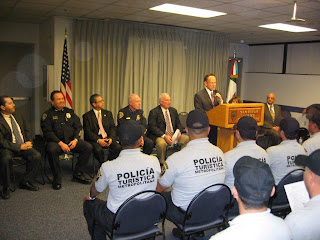
Twenty-two police officers from Tijuana, Playas de Rosarito and Ensenada were recognized for completing a one-day course at the San Diego police academy to prepare for the April 1 launch of the new force, a joint effort of the cities to patrol a 70-mile stretch of Pacific coastline.

Americans have stayed away in the past year, largely because of media exagerations and false perceptions of violence affecting tourism.

"It won't be magic, but at least we're trying," William Yu, Tijuana's liaison for binational affairs, told the officers Thursday as he prepared them for the ceremony.

San Diego Mayor Jerry Sanders said during Friday's event at the city's police headquarters that the new force should ease tourists' understandable concerns about safety.

I’m confident that this relationship will enable us to expand tourism opportunities on both sides of the border,” San Diego Mayor Jerry Sanders told an audience of officers, mayors and representatives from both the Mexican and U.S. consulates.

The Metropolitan Tourist Police will join with other agencies in patrolling parts of the 70-mile tourist corridor from Tijuana to Ensenada. They will offer special assistance to visitors and also can issue bilingual traffic tickets that can be paid from the U.S.

The officers, who will have their own uniforms and cars, said they liked a visit during the class to a simulated shooting range in which they were asked to react to threatening scenarios played on a video screen.

San Diego police Sgt. David Landman also drew on training material that is widely used by California law enforcement agencies, including role-playing techniques with an emphasis on how to treat people respectfully.

Landman, who oversees training for veteran San Diego officers, quizzed the officers often.

"If a police officer runs a stop sign, it sends a very bad signal to the people," one said.

"You must practice what you preach, set an example for the people," another chimed in.

The officers will return to Mexico to train colleagues in each of the three cities for the special force, which is expected to eventually have 350 officers. Playas de Rosarito, widely known as Rosarito Beach, will begin with 30 officers. Tijuana expects to start with about 60.

Some Mexican officials and American expatriates said the region has been unfairly tarnished, partly by recycled media reports of violence against tourists more than two years ago. Officials said the vast majority of murder victims were small-time drug dealers caught in turf battles.

The battered tourism industry remains an economic pillar of Mexico's northern Baja California peninsula.

Yet in Rosarito Beach, authorities estimated the number of visitors during the high season of April to November slid 70 percent from 2005 to 2009. Tourism accounts for about 60 percent of the economy in the city of 120,000 people.

Approximately 15% of these residents are American expats

Obviously, great deals and amazing prices -from groceries and souvenirs to hotels and real estate, can be found in the Rosarito Beach and Ensenada areas at the moment.
In fact, northern Baja is preparing a major advertising campaing, both in the US and Mexico... and branding the beautiful norhtern Baja area with the name of "Riviera Baja"
"We need to show everyone the beauties and richenes of this part of Mexico... said Hugo Torres, Rosarito Beach´s mayor.

The Baja Riviera branding is supported by the city governments of Rosarito Beach, Ensenada and Tijuana and by all business and civil organizations in the Baja area.

http://www.bajainvestment.com/

Tuesday, December 1, 2009

Weekly Fishing Column: Punta Colonet well worth trip to Baja

The Daily Breeze
By Phil Friedman, Correspondent


Punta Colonet is located 120 miles south of the Mexican border in Tijuana.


The drive there takes you through some of the most picturesque geography of northern Baja California. You will pass through Tijuana, Rosarito Beach, Ensenada, the Baja Wine Country and more.


Highway Mexico 1 will take you through breath-taking views of the Coronado Islands, sheer cliffs, fish taco stands and wonderfully warm Baja California people. Hugo Torres, Mayor of Rosarito Beach, has done everything in his power to make Rosarito safe. The fact is, despite the fact no tourists have been killed in Northern Baja, the 24-hour news cycle as well as other influences have made the drive to Baja less desirable.


I have driven to Cabo San Lucas five times in the last two years without incident and have hooked my two sons on the Baja experience. There is so much to love about a road trip to Baja but for my sons, it always comes down to the warm and friendly people of Baja.


There is another way to get to Punta Colonet. You can jump on a sportboat out of San Diego for the next several months and enjoy spectacular fishing.


Yes, you will miss the people and the drive but you will experience the rich and bountiful seas of Punta Colonet.


Mike Acker of Long Beach made the trip on the New Lo-An last weekend.


"This was as good as fishing as I have ever seen," Acker said.


"Huge lingcod, big red snapper, halibut and more," he continued. "If


you are into action and great eating fish then this is it."
Acker said from the time they arrived, it was constant action on a variety of fish. In fact, while Acker is not a big fan of bottom fishing, he soon became a convert.


"You only fish in about 200 feet of water so you feel the fight," he said. "Besides, these are some of the best, if not the best eating fish of the sea."


Nothing makes a better fish taco than a colonet red snapper. Deep fried and battered, the filet is put in a corn tortilla and then garnished with salsa, cilantro, onions, guacamole, sour cream and more. You talk about culinary ecstasy, this is it. Put some rice and beans on the side and you have a meal that your guests will remember for a long time to come.


Proper tackle on a colonet trip only requires a couple of outfits. A 25- and 40- pound outfit will be perfect. Eight- to 16-ounce sinkers are perfect along with 3-O hooks. Lingcod are another aggressive and delicious fish that are bountiful off Punta Colonet. Tagging studies show that lingcod are largely non-migratory and colonize in localized areas.


Lingcod live on the bottom, but may feed throughout the water column. And unlike many other bottom fish species like rockfish, lingcod do not have an air bladder, which enables them to freely swim up and down the water column without injury. Sport or commercial anglers can haul lingcod from depths of 500 feet or more to the surface and release them unharmed. Hard-fighting, great eating and yet another reason to head south of the border.


This Friday night, the Pacific Queen is departing from Fisherman's Landing in San Diego on a weekend trip to the rich waters of Colonet. The tips is priced at $250 with food and permits extra.


www.bajainvestment.com

Wednesday, June 10, 2009

Baja Is Safe For Visitors, Says Ranking U.S. Diplomat

ROSARITO BEACH, BAJA CALIFORNIA, MEXICO---Baja is safe for visitors and he hopes its vital tourism sector quickly rebounds, a leading U.S. diplomat told El Mexicano newspaper in a front-page story published Monday.

Ronald Kramer, head of the U.S Consulate in Tijuana, said that some coverage of Mexico’s war against drug cartels had falsely created the impression in the U.S. that the area is unsafe for visitors.

While the bi-national effort against drug cartels is a serious one, visitors are not targeted, Kramer said. He also praised the Mexican army and authorities for their successes in the effort.

Kramer expects efforts by Mexican leaders, including Rosarito Beach Hugo Torres, to be successful in rebuilding Mexico’s image, but said the country’s economy and many of its people currently are suffering because of the significant loss of tourism dollars.

Kramer also said concerns in past weeks about the H1N1 virus (also known as the swine flu) had hurt the area’s economy.

He cited as an example some cruise lines canceling voyages to Ensenada and diverting them to San Diego, which actually had more confirmed cases of the flu.

MEDIA CONTACT:Ron Raposa

www.bajainvestment.com

Friday, March 27, 2009

Is Mexico safer than New Orleans?

Posted by Jason Clampet at 3/26/2009

I've been a big fan of Baja California ever since I lived in Los Angeles and began taking frequent trips to the peninsula. I'm not sure, though, how accurate my impressions of the place are now, considering that I spent all of my time there before the uptick in violence that began in 2008. From the recent press reports and the warnings coming from the State Department as well as TV talk-show hosts, you'd think all of Mexico was a death trap waiting to snap shut on you as soon as you cleared customs in Tijuana, Mexico City, Cancun, or Cabo San Lucas.

I got sick of sifting through all the "don't go to Mexico" stories out there, so I emailed Hugo Torres, the mayor of Rosarito, for some perspective. Rosarito, a 20-minute drive from downtown Tijuana, became a hot spot in the early 2000s for southern Californians seeking affordable second homes. It's also a popular weekend spot for college kids and soldiers from the San Diego area.

Torres has a few biases, to say the least: in addition to being mayor, his family has long owned Rosarito's most notable hotel (Sinatra, Orson Welles, and Rita Hayworth were a few of its guests from Hollywood's Golden Age). But he's not an idiot, which is why he's not going to say "come on down, it's safe" if he thinks that'll lead to San Diego surfer getting kidnapped


"The best way [to know what's going on] is to talk to our frequent visitors or some of the 14,000 expatriates who live here," Mayor Torres emailed me. "They know from first-hand experience that Rosarito is safe and welcoming, perhaps more so than ever."


"The inaccurate perception of insecurity here has greatly reduced tourism. That perception, along with the U.S. economic slump, also has deeply impacted residential building. Together, it has been a tough economic hit. About 5 restaurants closed in this period, so far, one hotel closed for previous problem aggravated by the current crisis. Approximately 1,500 jobs have been lost."

A number of residential developments have been suspended or shut down completely, including a Trump condo tower that would have likely been a debacle with or without the violence and economic slump. Yesterday, Rosarito delayed until August a pro surfing contest that was to be held in April, citing a lack of sponsors and the need to wait until the media frenzy died down.

Torres trusts that will happen soon enough. "In general, the media that know us best and cover us most closely have presented the most accurate portrait. This includes, foremost, the San Diego Union-Triubune and also the Los Angeles Times. Pete Thomas, who writes the "Outposts" blog for the Times, has been excellent. Many of the sensationalized stories are done by reporters who seldom --- and sometimes never --- visit the area."

Like other Mexico boosters, Torres pushes the cartel-on-cartel violence story line. "The violence we have had has been primarily between rival factions of a drug cartels as more pressure is brought upon them; our visitors are not targeted nor is the typical resident affected. However, the inaccurate perception of insecurity here has greatly reduced tourism."

A vast majority -- over 90% by just about any count -- of those that have been killed in Tijuana and other cities are related to the drug trade in one way or another. It's also true that the violence is so concentrated in certain cities that there is rarely spillover into nearby towns, let alone other states. Baja California Sur, which takes up the southern half of the peninsula and includes La Paz and the Los Cabos area, had one drug-related murder this year, making the area safer than just about any city in the United States. Torres and others have pointed out that New Orleans, which almost everyone in the travel industry encourages people to visit, ranked third in 2008 for the most murders per capita in the world -- just between Cape Town, South Africa and Moscow, Russia.

That doesn't mean people shouldn't be careful when traveleing there. "We'd give pretty much the same advice that works for travelers anywhere," Torres says. "Stay in the popular tourist and business areas and avoid ones where things like drug dealing and prostitution occur. That won't be hard to do."

Photo credit:
Guadalupe Valley vineyards
Photo by jasoncedit


Gustavo Torres
www.bajainvestment.com