Showing posts with label Mexican border. Show all posts
Showing posts with label Mexican border. Show all posts
Monday, May 10, 2010


Friday, April 23, 2010
Follow the Money: Why the U.S. Mainstream Media has Mexico Under Seige
Follow the Money: Why the U.S. Mainstream Media has Mexico Under Seige
THE NEW GLOBAL ECONOMIC REALITY
by Charles Simpson, Mexinvestnow.com
First: A reality check on Mexico
Mexico is in a unique position to reap many of the benefits of the decline of the US economy. In order to not violate NAFTA and other agreements the U.S.A. cannot use direct protectionism, so it is content to allow the media to play this protectionist role. The U.S. media – over the last year – has portrayed Mexico as being on the brink of economic collapse and civil war. The Mexican people are either beheaded, kidnapped, poor, corrupt, or narco-traffickers. The American news media was particularly aggressive in the weeks leading up to spring break. The main reason for this is money. During that two-week period, over 120,000 young American citizens poured into Mexico and left behind hundreds of millions of dollars.

Let’s look at the reality of the massive drug and corruption problem, kidnappings, murders and money. The U.S. Secretary of State Clinton was clear in her honest assessment of the problem. “Our insatiable demand for illegal drugs fuels the drug trade. Our inability to prevent the weapons from being illegally smuggled across the border to arm these criminals causes the deaths of police officers, soldiers and civilians,” Clinton said. The other large illegal business that is smuggled into the U.S.A. that no one likes to talk about is Human Traffic for prostitution. This “business” is globally now competing with drugs in terms of profits.
It is critical to understand, however that the horrific violence in Mexico is over 95% confined to the three transshipping cities for these two businesses, Tijuana, Nogales, and Juarez. The Mexican government is so serious about fighting this, that they have committed over 30,000 soldiers to these borders towns. There was a thoughtful article written by a professor at the University of Juarez. He was reminded of the Prohibition years in the U.S.A. and compared Juarez to Chicago when Al Capone was conducting his reign of terror capped off with The Saint Valentine’s Day Massacre. During these years, just like Juarez today, 99% of the citizens went about their daily lives and attended classes, went to the movies, restaurants, and parks.
Is there corruption in Mexico? YES !!! Is there an equal amount of corruption related to this business in the U.S.A.? YES !!!. When you have a pair of illegal businesses that generate over $300,000,000,000 in sales you will find massive corruption. Make no mistake about the Mexican Drug Cartel; these “businessmen” are 100 times more sophisticated than the bumbling bootleggers during Prohibition. They form profitable alliances all over the U.S.A. They do cost benefit analysis of their business much better than the US automobile industry. They have found over the years that the cost of bribing U.S. and Mexican Border Guards and the transportation costs of moving marijuana from Sinaloa to California have cut significantly into profits. That is why over the past 5-7 years they have been growing marijuana in State and Federal Parks and BLM land all across America. From a business standpoint, this is a tremendous cost savings on several levels. Let’s look at California as an example as one of the largest consumers. When you have $14.2 billion of Marijuana grown and consumed in one state, there is savings on transportation, less loss of product due to confiscation and an overall reduction cost of bribery with law enforcement and parks service people. Another great savings is the benefit to their employees. The penalties in Mexico for growing range from 5-15 years. The penalties in California, on average are 18 months, and out in 8 months. The same economic principles are now being applied to the methamphetamine factories.

FOX News continues to scare people with its focus on kidnapping. There are kidnappings in Mexico. The concentration of kidnappings has been in Mexico City, among the very rich and the three aforementioned border Cities. With the exception of Mexico City, the number one city for kidnappings among NAFTA countries is Phoenix, Arizona with over 359 in 2008. The Phoenix Police estimate that twice that number of kidnappings goes unreported, because like Mexico 99% of these crimes were directly related to drug and human traffic. Phoenix, unfortunately, is geographically profitable transshipping location. Mexicans, just like 99% of U.S. Citizens during prohibition, go about their daily lives all over the country. They get up, go to school or work and live their lives untouched by the border town violence.
These same protectionist news sources have misled the public as to the real danger from the swine flu in Mexico and temporary devastated the tourism business. As of May 27 2009 there have been 87 deaths in Mexico from the swine flu. During those same five months there have been 36 murdered school children in Chicago. By their logic, if 87 deaths from the swine flu in Mexico warrants canceling flights and cruise ships to Mexico, then close all roads and highways in the USA because of record 43,359 automobile related deaths in the USA in 2008.
What is just getting underway is what many are calling the “Largest southern migration to Mexico of people and real estate assets since the Civil War” A significant percentage of the Baby Boomers have been doing the research and are making the life changing decision to move out of the U.S.A. The number one retirement destination in the world is Mexico. There are already over 2,000,000 US and Canadian property owners in Mexico. The most conservative number of American and Canadian Baby Boomers who are on their way to owning property in Mexico for full or part time living in the next 15 years is over 6,000,000. Do the math on 6,000,000 people buying a $300,000 house or condo and you will understand why the U.S. Government is trying to tax this massive shift of money to Mexico through H.R. 3056. The U.S. government calls this “The Tax Collection Responsibility Act of 2007”. Those who will have to pay it are calling this the EXIT TAX.
Another large exodus from the U.S.A is high paying skilled jobs. The job shift in automobile sector, both car and parts manufacturing, is already known by most investors. In the last few months as John Deere and Caterpillar have been laying off thousands of workers in the U.S.A., and hiring equal numbers in Mexico. The most recent industry that is making the shift is the aerospace manufacturers. In the city of Zacatecas there is currently a $210 million aerospace facility being built. With the 11 U.S. companies moving there, it is estimated to provide over 200,000 new high paying jobs in the coming years. One of the main factors for the shift in job south to Mexico instead of China is realistic analysis of total production, labor and delivery costs. While the labor costs in China are 40% less on average, the overall transportation costs and inherent risks of a long distance supply chain, and quality control issues, gives Mexico a distinct financial advantage.
Mexico’s real economic future
Mexico has avoided completely the subprime problem that has devastated the U.S. banking industry. The Mexican banks are healthy and profitable. Mexico has a growing and very healthy middle and upper middle class. The very recent introduction of residential financing has Mexico in a unique position of having over 90% of current homeowners owning their house outright. U.S. banks are competing for the Mexican, Canadian and American cross border loan business. It is and will continue to be a very safe and very profitable business. These same banks that were loaning in a reckless manner have learned their lesson and are loaning here the old fashioned way. They require a minimum of a 680 credit score, 30% down payment, and verifiable income that can support the loan. In most areas of Mexico where Baby Boomers are moving to, with the exception of Puerto Penasco (which did not have a national and international base of buyers), there is no real estate bubble. The higher end markets ($2-20 million) in many of these destinations are going through a modest correction. The Baby Boomers market here is between $200,000 and $600,000. With the continuing demand inside the Bay of Banderas, that price point, in the coming years, will disappear. This is the reason the Mexican government is spending billions of dollars on more infrastructure north along the coast all the way up to Mazatlan.
The other major area where America has become overpriced is in the field of health care. This massive shift of revenues is estimated to add 5-7% to Mexico’s GDP. The name for this “business” is Medical Tourism. The two biggest competitors for Mexico were Thailand and India. Thailand and India’s biggest drawback is geography. Also recent events, Thailand’s inability to keep a government in place and the recent terrorist attack in Mumbai, have helped Mexico capture close to half of this growth industry. In Mexico today there are over 56 world class hospitals being built to keep up with this business.
Mexico is currently sitting on a cash surplus and an almost balanced budget. Most Americans have never heard of Carlos Slim until he loaned the New York Times $250 million. After that it became clear to many investors around the world what Mexicans already knew: that Mexico had been able to avoid the worst of the U.S. economic devastation. Mexico’s resilience is to be admired. When the U.S. Federal Reserve granted a $30 billion loan to each of the following countries Mexico, Singapore, South Korea, and Brazil, Mexico reinvested the money in Treasury bonds in an account in New York City.
According to oil traders, Mexico’s Pemex wisely as the price of oil shot to $147 a barrel put in place an investment strategy that hinged on oil trading in the range of $38-$60 a barrel. Since the beginning of 2009 Mexico has been collecting revenues on hedged positions that give them $90-$110 per barrel today. Mexico’s recent and under reported oil discovery in the Palaeo Channels of Chicontepec has placed it third in the world for oil reserves, right behind Canada and Saudi Arabia.
The following is a quote from Rosalind Wilson, President of the Canadian Chamber of Commerce on March 19, 2009. “The strength of the Mexican economic system makes the country a favorite destination for Canadian investment”.
OPPORTUNITIES: WHY PUERTO VALLARTA & THE RIVIERA NAYARIT?
The answer is simple and old fashioned: SUPPLY AND DEMAND.
The area of Puerto Vallarta/Riviera Nayarit inside the Bay of Banderas is an investor’s dream. This area has the comprehensive infrastructure in place, world class hospitals and dental care, natural investment protection from the Sierra Madre Mountains, endless future water supply, low to nonexistent crime, international airport, and limited supply inside the Bay, first class private bilingual schools and higher than average appreciation potential. Like many areas in Mexico there is large demand for full and part time retirement living and a lot of construction underway to meet this demand. Pre construction of course is where the best bargains are available.
I would offer a word of caution for investors in Mexico. Do not be seduced by the endless natural beauty that is everywhere, both inland in colonial towns and along thousands of miles of beach. Apply conservative medium and long term investment strategies without emotion. The demand for full and part time living by American and Canadian Baby Boomers is evident throughout the country. The top two choice locations are ocean front, and ocean view. The third overall choice, which is less expensive, is inland in one of the many beautiful colonial towns or small cities.
Mexico, with the world’s 13th largest GDP, is no longer a “Third World Country”, but rather a fast growing, economically secure state, as the most recent five-year history of its financial markets when compared to the U.S.A.’s financial markets suggests.
DOW JONES AVERAGES MAY 2004 10,200 MAY 2009 8,200 20% LOSS IN 5 YEARS.
MEXICAN BOLSA MAY 2004 10,000 MAY 2009 23,000 130% GAIN IN 5 YEARS
I am glad to share all of my research with investors.
http://www.bajainvestment.com/
THE NEW GLOBAL ECONOMIC REALITY
by Charles Simpson, Mexinvestnow.com
First: A reality check on Mexico
Mexico is in a unique position to reap many of the benefits of the decline of the US economy. In order to not violate NAFTA and other agreements the U.S.A. cannot use direct protectionism, so it is content to allow the media to play this protectionist role. The U.S. media – over the last year – has portrayed Mexico as being on the brink of economic collapse and civil war. The Mexican people are either beheaded, kidnapped, poor, corrupt, or narco-traffickers. The American news media was particularly aggressive in the weeks leading up to spring break. The main reason for this is money. During that two-week period, over 120,000 young American citizens poured into Mexico and left behind hundreds of millions of dollars.

Let’s look at the reality of the massive drug and corruption problem, kidnappings, murders and money. The U.S. Secretary of State Clinton was clear in her honest assessment of the problem. “Our insatiable demand for illegal drugs fuels the drug trade. Our inability to prevent the weapons from being illegally smuggled across the border to arm these criminals causes the deaths of police officers, soldiers and civilians,” Clinton said. The other large illegal business that is smuggled into the U.S.A. that no one likes to talk about is Human Traffic for prostitution. This “business” is globally now competing with drugs in terms of profits.
It is critical to understand, however that the horrific violence in Mexico is over 95% confined to the three transshipping cities for these two businesses, Tijuana, Nogales, and Juarez. The Mexican government is so serious about fighting this, that they have committed over 30,000 soldiers to these borders towns. There was a thoughtful article written by a professor at the University of Juarez. He was reminded of the Prohibition years in the U.S.A. and compared Juarez to Chicago when Al Capone was conducting his reign of terror capped off with The Saint Valentine’s Day Massacre. During these years, just like Juarez today, 99% of the citizens went about their daily lives and attended classes, went to the movies, restaurants, and parks.
Is there corruption in Mexico? YES !!! Is there an equal amount of corruption related to this business in the U.S.A.? YES !!!. When you have a pair of illegal businesses that generate over $300,000,000,000 in sales you will find massive corruption. Make no mistake about the Mexican Drug Cartel; these “businessmen” are 100 times more sophisticated than the bumbling bootleggers during Prohibition. They form profitable alliances all over the U.S.A. They do cost benefit analysis of their business much better than the US automobile industry. They have found over the years that the cost of bribing U.S. and Mexican Border Guards and the transportation costs of moving marijuana from Sinaloa to California have cut significantly into profits. That is why over the past 5-7 years they have been growing marijuana in State and Federal Parks and BLM land all across America. From a business standpoint, this is a tremendous cost savings on several levels. Let’s look at California as an example as one of the largest consumers. When you have $14.2 billion of Marijuana grown and consumed in one state, there is savings on transportation, less loss of product due to confiscation and an overall reduction cost of bribery with law enforcement and parks service people. Another great savings is the benefit to their employees. The penalties in Mexico for growing range from 5-15 years. The penalties in California, on average are 18 months, and out in 8 months. The same economic principles are now being applied to the methamphetamine factories.

Playas de Rosarito, Baja California, Mex.
FOX News continues to scare people with its focus on kidnapping. There are kidnappings in Mexico. The concentration of kidnappings has been in Mexico City, among the very rich and the three aforementioned border Cities. With the exception of Mexico City, the number one city for kidnappings among NAFTA countries is Phoenix, Arizona with over 359 in 2008. The Phoenix Police estimate that twice that number of kidnappings goes unreported, because like Mexico 99% of these crimes were directly related to drug and human traffic. Phoenix, unfortunately, is geographically profitable transshipping location. Mexicans, just like 99% of U.S. Citizens during prohibition, go about their daily lives all over the country. They get up, go to school or work and live their lives untouched by the border town violence.
These same protectionist news sources have misled the public as to the real danger from the swine flu in Mexico and temporary devastated the tourism business. As of May 27 2009 there have been 87 deaths in Mexico from the swine flu. During those same five months there have been 36 murdered school children in Chicago. By their logic, if 87 deaths from the swine flu in Mexico warrants canceling flights and cruise ships to Mexico, then close all roads and highways in the USA because of record 43,359 automobile related deaths in the USA in 2008.
What is just getting underway is what many are calling the “Largest southern migration to Mexico of people and real estate assets since the Civil War” A significant percentage of the Baby Boomers have been doing the research and are making the life changing decision to move out of the U.S.A. The number one retirement destination in the world is Mexico. There are already over 2,000,000 US and Canadian property owners in Mexico. The most conservative number of American and Canadian Baby Boomers who are on their way to owning property in Mexico for full or part time living in the next 15 years is over 6,000,000. Do the math on 6,000,000 people buying a $300,000 house or condo and you will understand why the U.S. Government is trying to tax this massive shift of money to Mexico through H.R. 3056. The U.S. government calls this “The Tax Collection Responsibility Act of 2007”. Those who will have to pay it are calling this the EXIT TAX.
Mexico: A better economic choice than China
Another large exodus from the U.S.A is high paying skilled jobs. The job shift in automobile sector, both car and parts manufacturing, is already known by most investors. In the last few months as John Deere and Caterpillar have been laying off thousands of workers in the U.S.A., and hiring equal numbers in Mexico. The most recent industry that is making the shift is the aerospace manufacturers. In the city of Zacatecas there is currently a $210 million aerospace facility being built. With the 11 U.S. companies moving there, it is estimated to provide over 200,000 new high paying jobs in the coming years. One of the main factors for the shift in job south to Mexico instead of China is realistic analysis of total production, labor and delivery costs. While the labor costs in China are 40% less on average, the overall transportation costs and inherent risks of a long distance supply chain, and quality control issues, gives Mexico a distinct financial advantage.
Mexico’s real economic future
Mexico has avoided completely the subprime problem that has devastated the U.S. banking industry. The Mexican banks are healthy and profitable. Mexico has a growing and very healthy middle and upper middle class. The very recent introduction of residential financing has Mexico in a unique position of having over 90% of current homeowners owning their house outright. U.S. banks are competing for the Mexican, Canadian and American cross border loan business. It is and will continue to be a very safe and very profitable business. These same banks that were loaning in a reckless manner have learned their lesson and are loaning here the old fashioned way. They require a minimum of a 680 credit score, 30% down payment, and verifiable income that can support the loan. In most areas of Mexico where Baby Boomers are moving to, with the exception of Puerto Penasco (which did not have a national and international base of buyers), there is no real estate bubble. The higher end markets ($2-20 million) in many of these destinations are going through a modest correction. The Baby Boomers market here is between $200,000 and $600,000. With the continuing demand inside the Bay of Banderas, that price point, in the coming years, will disappear. This is the reason the Mexican government is spending billions of dollars on more infrastructure north along the coast all the way up to Mazatlan.
The other major area where America has become overpriced is in the field of health care. This massive shift of revenues is estimated to add 5-7% to Mexico’s GDP. The name for this “business” is Medical Tourism. The two biggest competitors for Mexico were Thailand and India. Thailand and India’s biggest drawback is geography. Also recent events, Thailand’s inability to keep a government in place and the recent terrorist attack in Mumbai, have helped Mexico capture close to half of this growth industry. In Mexico today there are over 56 world class hospitals being built to keep up with this business.
Mexico is currently sitting on a cash surplus and an almost balanced budget. Most Americans have never heard of Carlos Slim until he loaned the New York Times $250 million. After that it became clear to many investors around the world what Mexicans already knew: that Mexico had been able to avoid the worst of the U.S. economic devastation. Mexico’s resilience is to be admired. When the U.S. Federal Reserve granted a $30 billion loan to each of the following countries Mexico, Singapore, South Korea, and Brazil, Mexico reinvested the money in Treasury bonds in an account in New York City.
According to oil traders, Mexico’s Pemex wisely as the price of oil shot to $147 a barrel put in place an investment strategy that hinged on oil trading in the range of $38-$60 a barrel. Since the beginning of 2009 Mexico has been collecting revenues on hedged positions that give them $90-$110 per barrel today. Mexico’s recent and under reported oil discovery in the Palaeo Channels of Chicontepec has placed it third in the world for oil reserves, right behind Canada and Saudi Arabia.
The following is a quote from Rosalind Wilson, President of the Canadian Chamber of Commerce on March 19, 2009. “The strength of the Mexican economic system makes the country a favorite destination for Canadian investment”.
OPPORTUNITIES: WHY PUERTO VALLARTA & THE RIVIERA NAYARIT?
The answer is simple and old fashioned: SUPPLY AND DEMAND.
The area of Puerto Vallarta/Riviera Nayarit inside the Bay of Banderas is an investor’s dream. This area has the comprehensive infrastructure in place, world class hospitals and dental care, natural investment protection from the Sierra Madre Mountains, endless future water supply, low to nonexistent crime, international airport, and limited supply inside the Bay, first class private bilingual schools and higher than average appreciation potential. Like many areas in Mexico there is large demand for full and part time retirement living and a lot of construction underway to meet this demand. Pre construction of course is where the best bargains are available.
I would offer a word of caution for investors in Mexico. Do not be seduced by the endless natural beauty that is everywhere, both inland in colonial towns and along thousands of miles of beach. Apply conservative medium and long term investment strategies without emotion. The demand for full and part time living by American and Canadian Baby Boomers is evident throughout the country. The top two choice locations are ocean front, and ocean view. The third overall choice, which is less expensive, is inland in one of the many beautiful colonial towns or small cities.
Mexico, with the world’s 13th largest GDP, is no longer a “Third World Country”, but rather a fast growing, economically secure state, as the most recent five-year history of its financial markets when compared to the U.S.A.’s financial markets suggests.
DOW JONES AVERAGES MAY 2004 10,200 MAY 2009 8,200 20% LOSS IN 5 YEARS.
MEXICAN BOLSA MAY 2004 10,000 MAY 2009 23,000 130% GAIN IN 5 YEARS
I am glad to share all of my research with investors.
http://www.bajainvestment.com/
Thursday, January 21, 2010
New Baja Tourist Police Force
From Ron Raposa
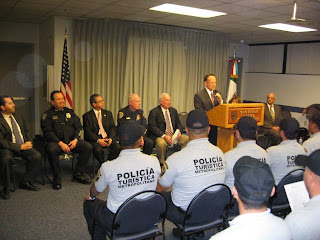
SAN DIEGO — Mexican cities south of the California border on Friday marked the launch of the new Metropolitan Tourist Police in an effort to regain the confidence of Americans looking for lobster dinners, cheap margaritas and pristine beaches.
Twenty-two police officers from Tijuana, Playas de Rosarito and Ensenada were recognized for completing a one-day course at the San Diego police academy to prepare for the April 1 launch of the new force, a joint effort of the cities to patrol a 70-mile stretch of Pacific coastline.
Americans have stayed away in the past year, largely because of media exagerations and false perceptions of violence affecting tourism.
"It won't be magic, but at least we're trying," William Yu, Tijuana's liaison for binational affairs, told the officers Thursday as he prepared them for the ceremony.
San Diego Mayor Jerry Sanders said during Friday's event at the city's police headquarters that the new force should ease tourists' understandable concerns about safety.
I’m confident that this relationship will enable us to expand tourism opportunities on both sides of the border,” San Diego Mayor Jerry Sanders told an audience of officers, mayors and representatives from both the Mexican and U.S. consulates.
The Metropolitan Tourist Police will join with other agencies in patrolling parts of the 70-mile tourist corridor from Tijuana to Ensenada. They will offer special assistance to visitors and also can issue bilingual traffic tickets that can be paid from the U.S.
The officers, who will have their own uniforms and cars, said they liked a visit during the class to a simulated shooting range in which they were asked to react to threatening scenarios played on a video screen.
San Diego police Sgt. David Landman also drew on training material that is widely used by California law enforcement agencies, including role-playing techniques with an emphasis on how to treat people respectfully.
Landman, who oversees training for veteran San Diego officers, quizzed the officers often.
"If a police officer runs a stop sign, it sends a very bad signal to the people," one said.
"You must practice what you preach, set an example for the people," another chimed in.
The officers will return to Mexico to train colleagues in each of the three cities for the special force, which is expected to eventually have 350 officers. Playas de Rosarito, widely known as Rosarito Beach, will begin with 30 officers. Tijuana expects to start with about 60.
Some Mexican officials and American expatriates said the region has been unfairly tarnished, partly by recycled media reports of violence against tourists more than two years ago. Officials said the vast majority of murder victims were small-time drug dealers caught in turf battles.
The battered tourism industry remains an economic pillar of Mexico's northern Baja California peninsula.
Yet in Rosarito Beach, authorities estimated the number of visitors during the high season of April to November slid 70 percent from 2005 to 2009. Tourism accounts for about 60 percent of the economy in the city of 120,000 people.
Approximately 15% of these residents are American expats
Obviously, great deals and amazing prices -from groceries and souvenirs to hotels and real estate, can be found in the Rosarito Beach and Ensenada areas at the moment.
In fact, northern Baja is preparing a major advertising campaing, both in the US and Mexico... and branding the beautiful norhtern Baja area with the name of "Riviera Baja"
"We need to show everyone the beauties and richenes of this part of Mexico... said Hugo Torres, Rosarito Beach´s mayor.
The Baja Riviera branding is supported by the city governments of Rosarito Beach, Ensenada and Tijuana and by all business and civil organizations in the Baja area.
http://www.bajainvestment.com/
SAN DIEGO — Mexican cities south of the California border on Friday marked the launch of the new Metropolitan Tourist Police in an effort to regain the confidence of Americans looking for lobster dinners, cheap margaritas and pristine beaches.
Twenty-two police officers from Tijuana, Playas de Rosarito and Ensenada were recognized for completing a one-day course at the San Diego police academy to prepare for the April 1 launch of the new force, a joint effort of the cities to patrol a 70-mile stretch of Pacific coastline.
Americans have stayed away in the past year, largely because of media exagerations and false perceptions of violence affecting tourism.
"It won't be magic, but at least we're trying," William Yu, Tijuana's liaison for binational affairs, told the officers Thursday as he prepared them for the ceremony.
San Diego Mayor Jerry Sanders said during Friday's event at the city's police headquarters that the new force should ease tourists' understandable concerns about safety.
I’m confident that this relationship will enable us to expand tourism opportunities on both sides of the border,” San Diego Mayor Jerry Sanders told an audience of officers, mayors and representatives from both the Mexican and U.S. consulates.
The Metropolitan Tourist Police will join with other agencies in patrolling parts of the 70-mile tourist corridor from Tijuana to Ensenada. They will offer special assistance to visitors and also can issue bilingual traffic tickets that can be paid from the U.S.
The officers, who will have their own uniforms and cars, said they liked a visit during the class to a simulated shooting range in which they were asked to react to threatening scenarios played on a video screen.
San Diego police Sgt. David Landman also drew on training material that is widely used by California law enforcement agencies, including role-playing techniques with an emphasis on how to treat people respectfully.
Landman, who oversees training for veteran San Diego officers, quizzed the officers often.
"If a police officer runs a stop sign, it sends a very bad signal to the people," one said.
"You must practice what you preach, set an example for the people," another chimed in.
The officers will return to Mexico to train colleagues in each of the three cities for the special force, which is expected to eventually have 350 officers. Playas de Rosarito, widely known as Rosarito Beach, will begin with 30 officers. Tijuana expects to start with about 60.
Some Mexican officials and American expatriates said the region has been unfairly tarnished, partly by recycled media reports of violence against tourists more than two years ago. Officials said the vast majority of murder victims were small-time drug dealers caught in turf battles.
The battered tourism industry remains an economic pillar of Mexico's northern Baja California peninsula.
Yet in Rosarito Beach, authorities estimated the number of visitors during the high season of April to November slid 70 percent from 2005 to 2009. Tourism accounts for about 60 percent of the economy in the city of 120,000 people.
Approximately 15% of these residents are American expats
Obviously, great deals and amazing prices -from groceries and souvenirs to hotels and real estate, can be found in the Rosarito Beach and Ensenada areas at the moment.
In fact, northern Baja is preparing a major advertising campaing, both in the US and Mexico... and branding the beautiful norhtern Baja area with the name of "Riviera Baja"
"We need to show everyone the beauties and richenes of this part of Mexico... said Hugo Torres, Rosarito Beach´s mayor.
The Baja Riviera branding is supported by the city governments of Rosarito Beach, Ensenada and Tijuana and by all business and civil organizations in the Baja area.

http://www.bajainvestment.com/
Tuesday, December 1, 2009
Weekly Fishing Column: Punta Colonet well worth trip to Baja
The Daily Breeze
By Phil Friedman, Correspondent
Punta Colonet is located 120 miles south of the Mexican border in Tijuana.
The drive there takes you through some of the most picturesque geography of northern Baja California. You will pass through Tijuana, Rosarito Beach, Ensenada, the Baja Wine Country and more.
Highway Mexico 1 will take you through breath-taking views of the Coronado Islands, sheer cliffs, fish taco stands and wonderfully warm Baja California people. Hugo Torres, Mayor of Rosarito Beach, has done everything in his power to make Rosarito safe. The fact is, despite the fact no tourists have been killed in Northern Baja, the 24-hour news cycle as well as other influences have made the drive to Baja less desirable.
I have driven to Cabo San Lucas five times in the last two years without incident and have hooked my two sons on the Baja experience. There is so much to love about a road trip to Baja but for my sons, it always comes down to the warm and friendly people of Baja.
There is another way to get to Punta Colonet. You can jump on a sportboat out of San Diego for the next several months and enjoy spectacular fishing.
Yes, you will miss the people and the drive but you will experience the rich and bountiful seas of Punta Colonet.
Mike Acker of Long Beach made the trip on the New Lo-An last weekend.
"This was as good as fishing as I have ever seen," Acker said.
"Huge lingcod, big red snapper, halibut and more," he continued. "If
you are into action and great eating fish then this is it."
Acker said from the time they arrived, it was constant action on a variety of fish. In fact, while Acker is not a big fan of bottom fishing, he soon became a convert.
"You only fish in about 200 feet of water so you feel the fight," he said. "Besides, these are some of the best, if not the best eating fish of the sea."
Nothing makes a better fish taco than a colonet red snapper. Deep fried and battered, the filet is put in a corn tortilla and then garnished with salsa, cilantro, onions, guacamole, sour cream and more. You talk about culinary ecstasy, this is it. Put some rice and beans on the side and you have a meal that your guests will remember for a long time to come.
Proper tackle on a colonet trip only requires a couple of outfits. A 25- and 40- pound outfit will be perfect. Eight- to 16-ounce sinkers are perfect along with 3-O hooks. Lingcod are another aggressive and delicious fish that are bountiful off Punta Colonet. Tagging studies show that lingcod are largely non-migratory and colonize in localized areas.
Lingcod live on the bottom, but may feed throughout the water column. And unlike many other bottom fish species like rockfish, lingcod do not have an air bladder, which enables them to freely swim up and down the water column without injury. Sport or commercial anglers can haul lingcod from depths of 500 feet or more to the surface and release them unharmed. Hard-fighting, great eating and yet another reason to head south of the border.
This Friday night, the Pacific Queen is departing from Fisherman's Landing in San Diego on a weekend trip to the rich waters of Colonet. The tips is priced at $250 with food and permits extra.
www.bajainvestment.com
Subscribe to:
Posts (Atom)