Carefully observing the changing demographics of US society, Mexico's federal government is wagering that the graying of Gringolandia will give a strong impulse to medical tourism.
"A million baby boomers, as they are called in the US, could come to live in Mexico in the coming years," said Mexican Health Minister Jose Angel Cordova Villalobos at an event held earlier this month in Mexico to mark National Nursing Day.
An opportunity exists, Cordova said, for tourism promoters to sell not only sun and sand but also "treatments or surgeries."
In coordination with other federal agencies, the Health Ministry plans to build up the medical tourism infrastructure during the next two years.
Important components of the initiative include training a corps of bilingual Spanish-English nurses, and increasing the number of private Mexican hospitals accredited by a joint US-Mexico commission already at work.
According to Cordova, eight such private institutions have been certified under the commission's standards.
Although regional initiatives to promote medical tourism are underway in the northern border states of Chihuahua, Baja California and Nuevo Leon, Cordova said greater coordination at the federal level is needed to tap a global market enjoyed by nations including Thailand, India, Costa Rica and Brazil. Mexico's leading health official stressed the new program will benefit the private sector.
"This is going to be an incentive for the private market," Cordova said. Cordova acknowledged that training bilingual nurses risks a bigger brain drain to the US, where some localities are already recruiting Mexican nurses for much higher pay than they receive at home, but he was careful to add the envisioned training will focus on elite sectors of Mexican health care delivery like cosmetic surgery and other specialized treatments.
Pilot programs to train bilingual nurses are in the stage of preparation, Cordova added.
Whether or not medical tourism booms in Mexico will depend on a variety of social, economic, political and security trends both to the north and south of the border.
Continued violence in parts of the border region is likely to hamper potential growth in the short-term.
A big factor will be the outcome of so-called health care reform in the US, especially if legislation is passed that increases rather than lowers costs as the Obama administration proposes.
Medical Tourism in a Tourist Town
A former head of the Puerto Vallarta Medical Association who currently serves on the municipal health committee, Dr. Jorge Roberto Cortes, or "Doctor Jorge" as he likes to be called, is skeptical that health care will be a bigger reason for people to come to Mexico than it is now.
Still, coincidental visits to the doctor or dentist are increasingly important in tourist destinations like Puerto Vallarta. For instance, Cortes estimated his patient load consists of 50 percent foreigners and 50 percent Mexican nationals.
In Puerto Vallarta and elsewhere in Mexico, sick tourists from the US will discover that medical costs are far cheaper than at home. According to Cortes, office visits hover around $40, while x-rays costing as little as $40 can be turned around in less than 45 minutes.
After several years in the US that included a stint at Mt. Sinai, Cortes speaks English with barely a hint of an accent. And he is not the only local, bilingual health care provider.
A city of more than 300,000 people, Puerto Vallarta has a plethora of public and private hospitals, hundreds of doctors, modern medical labs and ready medical evacuation services.
"It´s a lot, but Vallarta is growing up," the general practitioners said. "We have all the specialties. You die if you want to. We have everything here."
A local medical services guide distributed in Puerto Vallarta contains ten pages advertising specialists, family doctors and even psychologists.
On its website, the Guadalajara-headquartered San Javier Hospital lists foreign insurance companies from which it will accept payments.
The companies include Cigna, Aetna, Tricare and International Health Insurance of Denmark, among others.
The hospital advertises birth delivery for about $700 and hysterectomies for approximately $1,000. The prices include one and two night hospital stays, respectively.
Another local facility, Medasist Hospital, charges less than $30 for a short emergency room visit, between $20-$30 for urgent care, and from $90 to $120 per night for hospital rooms. Doctor's fees are extra.
Dr. Cortes is among the physicians who prefer to deal on a cash basis. Echoing complaints familiar in the US, Cortes said bureaucratic delays and nay-saying can make private insurers troublesome.
Typically, insurance companies take months to pay Mexican health care providers.
In tropical areas like Puerto Vallarta, new residents and tourists should be aware of the possibility of contracting unfamiliar illnesses like dengue.
The State of Jalisco operates a spraying program to eradicate mosquitoes in Puerto Vallarta, but at least 13 people contracted the disease in January according to a state health department report cited in the press.
From Braceros to Baby Boomers
Hailing from a nurse's family in California's San Joaquin Valley, Pamela Thompson once treated Mexican farm workers in the emergency room. Nowadays, Thompson's HeathCare Resources Puerto Vallarta company networks US expatriates and tourists with Mexican healthcare providers.
Thompson said interest in Mexican medical care is growing among both US consumers and private insurers.
Interviewed on a busy high season day, the consultant said the recession had not significantly slowed visits from foreigners, especially gay men, seeking operations like plastic surgery.
According to HealthCare Resources Puerto Vallarta's website, several specialized surgical packages are 30-40 percent cheaper in Mexico than in the US and Canada.
Thompson said she had received recent inquiries from US-based insurance companies about sending patients to Mexico. "I think that's going to happen soon," Thompson said. "(Private insurers) are starting to think about it, talk about it."
According to Thompson, four basic types of insurance are available to foreign tourists and residents in Mexico — international, travel, private Mexican, and state-run Mexican Social Security Institute (IMSS) coverage.
For short-term or winter season visitors to Mexico known as "snowbirds," travel insurance is the most practical option, Thompson asserted.
The former nurse said many US citizens are surprised to learn that private health insurance in Mexico costs as low as $1,500 per year, though a huge drawback for many is that companies will not cover anyone over 62 years of age.
Fulltime residents of Mexico who hold FM-3 visas can now qualify for IMSS coverage, Thompson said, cautioning the public system is overloaded and quality far from desirable. Still, she said, IMSS insurance is "absolutely better than nothing.
" For the truly destitute foreigner, regional public hospitals will accept an admission.
Given the aging of many US residents of Mexico, the inability to use Medicare to pay for health-related expenses south of the border is problematic for many expatriates and potential immigrants — at least until now. Meantime, the growing size of the US retiree population in places like Puerto Vallarta has attracted the notice of hospitals north of the border, which offer free health clinics in Mexico during the high season to court potential patients.
In conjunction with hospitals, Thompson said she had facilitated transfers of US retirees from Puerto Vallarta to institutions back in the old country.
Yet increasingly, Thompson said she had been witness to another tendency: younger US citizens relocating with their families to Puerto Vallarta.
The possibility of working at home via the Internet favors this trend, the longtime resident of Puerto Vallarta added. "I've had more calls for pediatricians here during the last 6 months," Thompson said.
Intimately familiar with the local scene, Thompson acknowledged there were "quacks" around "just like everywhere else." But the health care professional stood by the overall quality of doctors and services available in the Pacific port city.
"We have great physicians in the area. The doctors here spend time with you," Thompson said. "You can call them on a cell-phone and you don't have to go through 20 people to get an appointment. All the doctors I work with are like that."
In Mexico, getting personal recommendations from knowledgeable locals is a good way of rooting out the frauds.
What about the Old Choppers?
Back in the US, meanwhile, the issue of dental treatment has been virtually absent from the so-called health care reform debate.
But a glance at rates charged by Mexican dentists quickly reveals a continued, major attraction for both tourists and prospective immigrants.
Not far from Cortes' office, and just off a bridge that crosses the Cuale River with its tropical denizens of darting birds and fighting iguanas, dentists Jessica Portuguez and Gloria Carrillo staff an Old Town Vallarta branch of Solu/Dent, a privately-owned business.
Recently, the clinic offered two cleanings for $12 and extractions for $9 per tooth. According to Carrillo, five porcelain teeth for a bridge cost approximately $500.
After three years in business at the site, Portuguez and Carrillo estimate that 40 percent of their patients are foreigners during the tourist high season which spans the months from October to March.
Local expatriates, who include customers from the nearby, old hippie settlement of Yelapa, spread Solu/Dent's name by word-of-mouth and bring in family members and friends. "They like how we attend them here," Carrillo contended.
A graduate of the University of Veracruz, Portuguez came to Puerto Vallarta two years ago after hearing how the large floating and resident foreign population created ample work opportunities for new dentists.
According to the relocated southerner, Mexican dentists must complete five years of studies and one year of social service to obtain basic licensure. "We have very accessible prices and good quality," Portuguez said.
"We have trained doctors. We studied for this. All work is guaranteed."
In Puerto Vallarta, "English-speaking" signs are visibly posted outside many dentists' offices.
Portuguez, who said she studies English in her spare time, assured that a bilingual receptionist was available to help the office's dentists translate with patients.
Solu/Dent recently opened a third branch in Bucerias, a community just north of Puerto Vallarta where many US-born immigrants have moved.
"We hope nothing changes and we stay here," Portuguez said.
http://www.bajainvestment.com/
Wednesday, February 3, 2010


Thursday, January 21, 2010
New Baja Tourist Police Force
From Ron Raposa
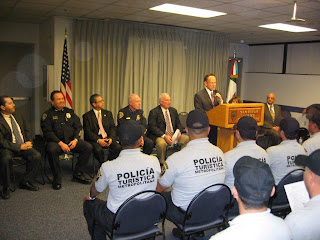
SAN DIEGO — Mexican cities south of the California border on Friday marked the launch of the new Metropolitan Tourist Police in an effort to regain the confidence of Americans looking for lobster dinners, cheap margaritas and pristine beaches.
Twenty-two police officers from Tijuana, Playas de Rosarito and Ensenada were recognized for completing a one-day course at the San Diego police academy to prepare for the April 1 launch of the new force, a joint effort of the cities to patrol a 70-mile stretch of Pacific coastline.
Americans have stayed away in the past year, largely because of media exagerations and false perceptions of violence affecting tourism.
"It won't be magic, but at least we're trying," William Yu, Tijuana's liaison for binational affairs, told the officers Thursday as he prepared them for the ceremony.
San Diego Mayor Jerry Sanders said during Friday's event at the city's police headquarters that the new force should ease tourists' understandable concerns about safety.
I’m confident that this relationship will enable us to expand tourism opportunities on both sides of the border,” San Diego Mayor Jerry Sanders told an audience of officers, mayors and representatives from both the Mexican and U.S. consulates.
The Metropolitan Tourist Police will join with other agencies in patrolling parts of the 70-mile tourist corridor from Tijuana to Ensenada. They will offer special assistance to visitors and also can issue bilingual traffic tickets that can be paid from the U.S.
The officers, who will have their own uniforms and cars, said they liked a visit during the class to a simulated shooting range in which they were asked to react to threatening scenarios played on a video screen.
San Diego police Sgt. David Landman also drew on training material that is widely used by California law enforcement agencies, including role-playing techniques with an emphasis on how to treat people respectfully.
Landman, who oversees training for veteran San Diego officers, quizzed the officers often.
"If a police officer runs a stop sign, it sends a very bad signal to the people," one said.
"You must practice what you preach, set an example for the people," another chimed in.
The officers will return to Mexico to train colleagues in each of the three cities for the special force, which is expected to eventually have 350 officers. Playas de Rosarito, widely known as Rosarito Beach, will begin with 30 officers. Tijuana expects to start with about 60.
Some Mexican officials and American expatriates said the region has been unfairly tarnished, partly by recycled media reports of violence against tourists more than two years ago. Officials said the vast majority of murder victims were small-time drug dealers caught in turf battles.
The battered tourism industry remains an economic pillar of Mexico's northern Baja California peninsula.
Yet in Rosarito Beach, authorities estimated the number of visitors during the high season of April to November slid 70 percent from 2005 to 2009. Tourism accounts for about 60 percent of the economy in the city of 120,000 people.
Approximately 15% of these residents are American expats
Obviously, great deals and amazing prices -from groceries and souvenirs to hotels and real estate, can be found in the Rosarito Beach and Ensenada areas at the moment.
In fact, northern Baja is preparing a major advertising campaing, both in the US and Mexico... and branding the beautiful norhtern Baja area with the name of "Riviera Baja"
"We need to show everyone the beauties and richenes of this part of Mexico... said Hugo Torres, Rosarito Beach´s mayor.
The Baja Riviera branding is supported by the city governments of Rosarito Beach, Ensenada and Tijuana and by all business and civil organizations in the Baja area.
http://www.bajainvestment.com/
SAN DIEGO — Mexican cities south of the California border on Friday marked the launch of the new Metropolitan Tourist Police in an effort to regain the confidence of Americans looking for lobster dinners, cheap margaritas and pristine beaches.
Twenty-two police officers from Tijuana, Playas de Rosarito and Ensenada were recognized for completing a one-day course at the San Diego police academy to prepare for the April 1 launch of the new force, a joint effort of the cities to patrol a 70-mile stretch of Pacific coastline.
Americans have stayed away in the past year, largely because of media exagerations and false perceptions of violence affecting tourism.
"It won't be magic, but at least we're trying," William Yu, Tijuana's liaison for binational affairs, told the officers Thursday as he prepared them for the ceremony.
San Diego Mayor Jerry Sanders said during Friday's event at the city's police headquarters that the new force should ease tourists' understandable concerns about safety.
I’m confident that this relationship will enable us to expand tourism opportunities on both sides of the border,” San Diego Mayor Jerry Sanders told an audience of officers, mayors and representatives from both the Mexican and U.S. consulates.
The Metropolitan Tourist Police will join with other agencies in patrolling parts of the 70-mile tourist corridor from Tijuana to Ensenada. They will offer special assistance to visitors and also can issue bilingual traffic tickets that can be paid from the U.S.
The officers, who will have their own uniforms and cars, said they liked a visit during the class to a simulated shooting range in which they were asked to react to threatening scenarios played on a video screen.
San Diego police Sgt. David Landman also drew on training material that is widely used by California law enforcement agencies, including role-playing techniques with an emphasis on how to treat people respectfully.
Landman, who oversees training for veteran San Diego officers, quizzed the officers often.
"If a police officer runs a stop sign, it sends a very bad signal to the people," one said.
"You must practice what you preach, set an example for the people," another chimed in.
The officers will return to Mexico to train colleagues in each of the three cities for the special force, which is expected to eventually have 350 officers. Playas de Rosarito, widely known as Rosarito Beach, will begin with 30 officers. Tijuana expects to start with about 60.
Some Mexican officials and American expatriates said the region has been unfairly tarnished, partly by recycled media reports of violence against tourists more than two years ago. Officials said the vast majority of murder victims were small-time drug dealers caught in turf battles.
The battered tourism industry remains an economic pillar of Mexico's northern Baja California peninsula.
Yet in Rosarito Beach, authorities estimated the number of visitors during the high season of April to November slid 70 percent from 2005 to 2009. Tourism accounts for about 60 percent of the economy in the city of 120,000 people.
Approximately 15% of these residents are American expats
Obviously, great deals and amazing prices -from groceries and souvenirs to hotels and real estate, can be found in the Rosarito Beach and Ensenada areas at the moment.
In fact, northern Baja is preparing a major advertising campaing, both in the US and Mexico... and branding the beautiful norhtern Baja area with the name of "Riviera Baja"
"We need to show everyone the beauties and richenes of this part of Mexico... said Hugo Torres, Rosarito Beach´s mayor.
The Baja Riviera branding is supported by the city governments of Rosarito Beach, Ensenada and Tijuana and by all business and civil organizations in the Baja area.

http://www.bajainvestment.com/
Thursday, December 10, 2009
Mexican officials meeting in Santa Ana
By THERESA CISNEROS
THE ORANGE COUNTY REGISTER
ANTA ANA Leaders from across Southern and Baja California are gathering at the Police Department today to share information on public safety, economic development and regional infrastructure.
It's an ongoing effort to strengthen communication between cities on both sides of the border.
The discussions are taking place during the 2nd Bi-National Mayors of the Californias Summit – sponsored by the cities of Santa Ana and Rosarito Beach.
Mayor Miguel Pulido said such steps help Mexico become a stronger partner, which directly benefits the United States.
"A safer Mexico and a stronger Mexico is a better Mexico for us all," he said.
Local officials scheduled to participate include Orange County District Attorney Tony Rackauckas and Irvine Councilman Steven Choi. Mayors from Rosarito, Ensenada, Tijuana and Tecate are also participating.
They'll meet in small groups to talk about issues and draft plans.
They are trading ideas on renewable-energy technologies, water agencies and law enforcement.
The inaugural summit, held in Anaheim in January, focused mostly on boosting tourism in both regions, and was followed up by a summer meeting in Ensenada. The next gathering is scheduled for the spring in Rosarito.
Mayors on both sides say they're starting to see fruits from the increased communication.
The city of Ensenada, for example, has debuted new jail facilities and crime-predicting computer software based on what representatives witnessed during visits to the Santa Ana Police Department.

THE ORANGE COUNTY REGISTER
ANTA ANA Leaders from across Southern and Baja California are gathering at the Police Department today to share information on public safety, economic development and regional infrastructure.
It's an ongoing effort to strengthen communication between cities on both sides of the border.
The discussions are taking place during the 2nd Bi-National Mayors of the Californias Summit – sponsored by the cities of Santa Ana and Rosarito Beach.
Mayor Miguel Pulido said such steps help Mexico become a stronger partner, which directly benefits the United States.
"A safer Mexico and a stronger Mexico is a better Mexico for us all," he said.
Local officials scheduled to participate include Orange County District Attorney Tony Rackauckas and Irvine Councilman Steven Choi. Mayors from Rosarito, Ensenada, Tijuana and Tecate are also participating.
They'll meet in small groups to talk about issues and draft plans.
They are trading ideas on renewable-energy technologies, water agencies and law enforcement.
The inaugural summit, held in Anaheim in January, focused mostly on boosting tourism in both regions, and was followed up by a summer meeting in Ensenada. The next gathering is scheduled for the spring in Rosarito.
Mayors on both sides say they're starting to see fruits from the increased communication.
The city of Ensenada, for example, has debuted new jail facilities and crime-predicting computer software based on what representatives witnessed during visits to the Santa Ana Police Department.

Wednesday, December 2, 2009
By Dan Prescher
International Living
If you've ever entertained the thought of living the good life in Mexico, heed my words: There's never been an easier...a more lucrative...or a more exciting time to be there.
In fact, there's never been a better time in your lifetime to start a new life in Mexico.
Despite what you think you might know about this huge and diverse country (keep reading, I'm going to dispel some of the most common myths), there has never been a better time to consider a move here.
That's because, right now, three critical factors have come together in a way they rarely do.
My name is Dan Prescher. My wife, Suzan Haskins, and I have been living in Mexico for nearly seven years now. And I can say, with confidence: I've never seen so much opportunity to grab amazing property deals...to live so well for so little...to enjoy so gracious a lifestyle...
You may know that Mexico earned the #1 spot on International Living's Global Retirement Index in 2007 and 2008 and came second in 2009.
It's close to the U.S. and easy to get to... it offers great retiree benefits on everything from medical services to airfares...taxes are low, low, low...and so is the cost of living...
Why is this the best time in your lifetime to start a new life in Mexico?
Here are three compelling reasons in particular for you to investigate Mexico right now:
The peso to dollar value is at a high—your dollar goes farther than ever. The peso has lost around 30% of its value against the dollar since August of 2008. Your dollar buys more in Mexico today than it has in more than 15 years...since 1994, after an economic crisis in which Mexico's government cut three zeros off the end of peso denominations to create a "new peso".
Just from my personal experience: the bottle of wine that cost us $5.80 last year costs us $4.60 today. The bill for our phone and high-speed Internet service was $42 last year and is $33 today. A housekeeper, at 200 pesos per day, cost us $18 last year and $14 today. We're benefiting from even bigger savings on big-ticket items, of course. We recently bought a headboard for our king-size bed. At 6,400 pesos, it would have cost us $610 last year. But with the exchange rate, we paid just $457 for it.
As you might imagine, some expats who live here are taking advantage of the weakened peso to buy larger goods and appliances they've been putting off until now. They're getting a price break and stimulating the economy at the same time.
The recession has created a buyer's market for you. With fewer people shopping for second homes, sellers are willing to negotiate more on price and toss in enticing incentives.
And, of course, where the currency exchange really makes a difference is on property prices. Last year, we were considering buying a small home here in Merida to renovate and use for rental income. The Mexican owners wanted us to lock in the price at 520,000 pesos, which converted to about $50,000 then. This was at a time when the dollar was weakening against just about every currency in the world. Concerned that the dollar would continue to slide, we decided not to move forward with the transaction. If we had accepted their terms, though, and if the closing had taken place now, the house would have cost us $40,000. That's a pretty substantial saving.
I should clarify something here: Overall, real estate in Mexico has held its value. That's because Mexico is still basically a cash society. (Yes, you can get mortgage financing in Mexico and we can tell you how...but most people don't. They buy with cash.) Developers, for the most part, have been well capitalized and there hasn't been a "lending crisis" in Mexico.
Prior to the recession there was a real estate boom here, especially among foreign buyers of vacation homes. Property prices rose during that time, although they were never super inflated as they were in the U.S. Since most properties aren't leveraged, there is no reason for prices to fall as drastically as we've seen in the U.S. and elsewhere...although certain market have seen some big price "corrections."
But...while in most parts of Mexico prices aren't falling much, neither are they rising right now. Some owners (particularly those from the U.S.) who overextended themselves are now willing to sell at a discount. In resort communities like Puerto Vallarta and along the Riviera Maya, you'll find particularly good bargains. And because, thanks to the recession, there are fewer buyers, sellers are throwing in lots of extraordinary incentives...like covering association fees for up to five years, throwing in appliance and furniture packages, offering lucrative lease-back options, etc.
And if you buy a resale home or condo direct from the seller...that's where the real bargains are, especially if you buy from a Mexican owner and negotiate the price in pesos...
I'd also be remiss if I didn't explain that the global recession isn't the only reason there are less real estate buyers...especially foreigners...in Mexico today. You can thank the U.S. news media for keeping them away.
The U.S. news media has created a big opportunity for you...
The mainstream media has painted an unfair picture of Mexico. Media coverage of isolated violence and virus outbreaks in Mexico has kept some tourists and potential retirees at home. It's not a fair picture.
Yes, the drug war is real (in my opinion, the Mexican government is winning) and there are areas of Mexico that should be avoided...mostly at the border with the U.S. But the vast majority of Mexico is untouched by all this. (As for the recent flu outbreak, Mexico has received heaps of international praise about the immediate steps taken throughout the country to stop its spread.)
Truthfully, Suzan and I feel safer walking to and from our midtown home in Merida to parks, restaurants, and evening events than we did in Omaha. Rest assured, college students on Spring break, families with children, European backpackers, single women, elderly couples...they're all still safely visiting Mexico.
The window of opportunity won't be open forever. Mexican tourism officials are launching an international public relations campaign to boost Mexico's image as a tourist destination. Tourists become real estate buyers, especially once they learn all that you've just learned about Mexico.
If you're looking for a comfortable (even pampered) lifestyle for less than half what it would cost you up north... Mexico makes more sense than any other country
As I mentioned, International Living conducts an annual survey called the Global Retirement Index. In 2007, Mexico won for the first time. It won again in 2008. Here's why:
Mexico is the closest retirement haven to the U.S. This may not seem like a big deal, but believe me, the convenience of a short plane ride makes all the difference in the world when you want to get back home to family and friends or attend to business matters. Flights to and from Mexico are plentiful and inexpensive and most take less time than a coast-to-coast U.S. flight. From my home in Merida in southern Mexico, I can be in Miami or Houston in about two hours. If you want to, you can easily and safely drive here. (Suzan and I have made the drive several times and look forward to our next Mexico road trip.)
It is easier to get a resident visa in Mexico than in any other country. You might think Panama, Belize, and Costa Rica have easy resident requirement. Well, forget everything you might think you know about obtaining a visa anywhere else. The Mexican government has made it very easy for foreigners to live here. As I mentioned, we lived in Panama and Nicaragua (and Ecuador prior to coming to Mexico in 2002)...and the visa process, hands down, is easier in Mexico. The requirements are less restrictive than any country that I know of.
Mexico has a first-class retiree benefits program. You may know about Panama's excellent pensionado progam, but to be eligible for it, you have to get a visa. And in Panama, getting a visa can be tough. But see my point above: not only is it easy to get a visa in Mexico, but foreigners who are age 60 or older, with a valid Mexico resident visa are eligible for Mexico's Personas Adultas Mayores benefits program.
The program offers discounts on a wide range of services, including health-related ones (hospitals, doctors' visits, lab tests, medical devices, pharmacies, and dental work); cultural activities like theater tickets and entrance fees to museums and archaeological sites; transportation and accommodation, including airline tickets, buses, car rentals and purchase; and at hotels and many stores. Discounts can range from 5% to 50% off the full price of the good or service.
The cost of living in Mexico is low, low, low. With rapidly rising fuel, health care, food, taxes, and travel costs, it's nice to know there are still places where you can live well without burning through your savings. Mexico is one of those special places. Here, you can enjoy a lifestyle that's all but unaffordable for most Americans and Canadians. The cost of real estate is far, far lower than it is in the U.S. and Canada. Could you find a beachfront condo in the U.S. for less than $100,000? A home smack on the beach for less than $150,000? You can in Mexico. And you can live very well here on just $2,000 per month or less. Suzan and I do...
Sample monthly budget for a couple living well in Mexico:
Utilities (electricity, gas, water) $150
Household help (housekeeper and gardener once a week) $200
Groceries $400
Maintenance and fuel for one car $150
Entertainment (dining out and other activities) $250
Health care (two people at $240 per year for IMSS insurance, plus $70 per month for private-care incidentals) $110
Incidentals (clothes, household items, etc.) $300
Communication: phone, internet, cable TV $100
Monthly Total: $1,660
These expenses are all variable, of course. You may not use as much electricity or wanthousehold help, for example. If you don't own a home, you'll have rental expenses (add $300-$1,000/month for that). If you live in a city, you may not need a car so you can subtract those expenses (though you'll need to add bus or taxi fees) Homeowners will want to include an annual property tax—but that rarely comes to more than $200 per year).
Think of how much money you can save, simply by moving a few hours south!
You can get full-coverage health insurance in Mexico for less than $1 per day. Hospitals and health care providers in Mexico are of excellent quality. (I know...I live here.) Many doctors were trained in the U.S. or Europe and they speak English. Private health insurance, (through a major global provider) costs one-fourth to one half what you might be paying in the U.S. Doctors' visits and common medical procedures in Mexico, too, cost about one-fourth of what they do in the U.S., so many expats just pay out of pocket. But get this: if you have a resident visa, you can get health coverage through IMSS (Instituto Nacional de Seguridad Social). There's no age limit for signing up. This full-coverage health insurance runs from about $100 a year for children and adolescents, up to almost $300 for those over 60—and it includes prescription medications.
Taxes are ridiculously low—need I say more? Taxes are a fact of life, we all know that. And like all countries, Mexico levies a value-added tax on goods and services. But other taxes are practically non-existent. At the beginning of this year, for instance, we paid the annual property taxes on our 5,400-square-foot home in Merida. It was a laughably low $139! The annual tax bill on the beachfront lots we own on the Gulf Coast...$10. Unless you're working here, you probably won't pay income taxes. But if you are working...and you're self employed or working for a Mexican or other foreign corporation...you can legally exempt up to $91,400 in income on your U.S. taxes for 2009...for both you and your spouse! I'll tell you how to get more details on that in just a minute...but first...
Two more reasons to consider Mexico: full-time household help and the warm and welcoming Mexican people
As I said, Suzan and I live a better life here in Mexico than we've ever lived anywhere else. The quality of our lives has vastly improved since we left the U.S. (A big part of that is the better weather—it makes a big impact on your attitude!)
Another reason we're so happy here is because, for the first time in our lives, we can afford household help. We both like to cook, but we don't necessarily like cleaning up afterwards. And we don't care much for mopping floors or scrubbing toilets either. But for $20 per day (and in some places in Mexico you'll pay less) you can hire a full-time housekeeper. Same with a gardener and someone to clean your pool. Make no mistake, these are good wages for dignified work...if your experience is like ours, your housekeeper and gardener will be endearingly cheerful and helpful and become like members of your family.
That's the other extraordinary aspect to life in Mexico: the Mexican people themselves. Sociologists who have studied these things say that Mexicans are among the happiest people on earth. It shows in the generous ways they treat people and in the genteel ways they conduct their business and go about their lives.
Truly, Mexico today is like the U.S. was in the 1950s and 60s...but with today's modern amenities, of course. You'll find a strong sense of community and a family-focused life—which makes every day a genuine pleasure.
Plus, Mexico offers an astounding cultural vibrancy that we simply haven't found anywhere else. And while the pace is civilized and the environment welcoming and friendly, you can enjoy the comforts you've grown accustomed to—like Internet access, cable TV, well-stocked grocery stores, and first-run movies. That's all here, too.
In Mexico, you will have more free time to do the things you enjoy, but I daresay you'll enjoy your free time even more than ever before.
Your opportunity to triumph over the recession...
I'm certain you've experienced the backlash of the rotten global economy. Everyone has. Chances are, your dollars aren't going as far as they used to. Maybe your investment nest egg has lost some (or a lot) of its value. Maybe you've worked hard all your life and haven't been able to save much at all...and now you're more worried than ever about how to pay for your retirement...maybe you're worried that you'll never be able to retire.
According to a new report by the Washington, D.C.-based Center for Economic and Policy Research, most baby boomers haven't saved much and will be forced to work longer and/or move to a place where the cost of living is less. According to the experts, "Property taxes, health care and cost of living will force boomers to strongly consider moving to other countries, especially if they plan on living at the same level of comfort as they do now."
If you've been considering a move oversees...whether to retire or live more economically full-time or part-time...or if you're looking for a laidback, gentler place to live or own a vacation home...you should strongly consider Mexico. Do the research. Get the facts.
http://www.bajainvestment.com/
http://www.remax-baja.com/
International Living
If you've ever entertained the thought of living the good life in Mexico, heed my words: There's never been an easier...a more lucrative...or a more exciting time to be there.
In fact, there's never been a better time in your lifetime to start a new life in Mexico.
Despite what you think you might know about this huge and diverse country (keep reading, I'm going to dispel some of the most common myths), there has never been a better time to consider a move here.
That's because, right now, three critical factors have come together in a way they rarely do.
My name is Dan Prescher. My wife, Suzan Haskins, and I have been living in Mexico for nearly seven years now. And I can say, with confidence: I've never seen so much opportunity to grab amazing property deals...to live so well for so little...to enjoy so gracious a lifestyle...
You may know that Mexico earned the #1 spot on International Living's Global Retirement Index in 2007 and 2008 and came second in 2009.
It's close to the U.S. and easy to get to... it offers great retiree benefits on everything from medical services to airfares...taxes are low, low, low...and so is the cost of living...
Why is this the best time in your lifetime to start a new life in Mexico?
Here are three compelling reasons in particular for you to investigate Mexico right now:
The peso to dollar value is at a high—your dollar goes farther than ever. The peso has lost around 30% of its value against the dollar since August of 2008. Your dollar buys more in Mexico today than it has in more than 15 years...since 1994, after an economic crisis in which Mexico's government cut three zeros off the end of peso denominations to create a "new peso".
Just from my personal experience: the bottle of wine that cost us $5.80 last year costs us $4.60 today. The bill for our phone and high-speed Internet service was $42 last year and is $33 today. A housekeeper, at 200 pesos per day, cost us $18 last year and $14 today. We're benefiting from even bigger savings on big-ticket items, of course. We recently bought a headboard for our king-size bed. At 6,400 pesos, it would have cost us $610 last year. But with the exchange rate, we paid just $457 for it.
As you might imagine, some expats who live here are taking advantage of the weakened peso to buy larger goods and appliances they've been putting off until now. They're getting a price break and stimulating the economy at the same time.
The recession has created a buyer's market for you. With fewer people shopping for second homes, sellers are willing to negotiate more on price and toss in enticing incentives.
And, of course, where the currency exchange really makes a difference is on property prices. Last year, we were considering buying a small home here in Merida to renovate and use for rental income. The Mexican owners wanted us to lock in the price at 520,000 pesos, which converted to about $50,000 then. This was at a time when the dollar was weakening against just about every currency in the world. Concerned that the dollar would continue to slide, we decided not to move forward with the transaction. If we had accepted their terms, though, and if the closing had taken place now, the house would have cost us $40,000. That's a pretty substantial saving.
I should clarify something here: Overall, real estate in Mexico has held its value. That's because Mexico is still basically a cash society. (Yes, you can get mortgage financing in Mexico and we can tell you how...but most people don't. They buy with cash.) Developers, for the most part, have been well capitalized and there hasn't been a "lending crisis" in Mexico.
Prior to the recession there was a real estate boom here, especially among foreign buyers of vacation homes. Property prices rose during that time, although they were never super inflated as they were in the U.S. Since most properties aren't leveraged, there is no reason for prices to fall as drastically as we've seen in the U.S. and elsewhere...although certain market have seen some big price "corrections."
But...while in most parts of Mexico prices aren't falling much, neither are they rising right now. Some owners (particularly those from the U.S.) who overextended themselves are now willing to sell at a discount. In resort communities like Puerto Vallarta and along the Riviera Maya, you'll find particularly good bargains. And because, thanks to the recession, there are fewer buyers, sellers are throwing in lots of extraordinary incentives...like covering association fees for up to five years, throwing in appliance and furniture packages, offering lucrative lease-back options, etc.
And if you buy a resale home or condo direct from the seller...that's where the real bargains are, especially if you buy from a Mexican owner and negotiate the price in pesos...
I'd also be remiss if I didn't explain that the global recession isn't the only reason there are less real estate buyers...especially foreigners...in Mexico today. You can thank the U.S. news media for keeping them away.
The U.S. news media has created a big opportunity for you...
The mainstream media has painted an unfair picture of Mexico. Media coverage of isolated violence and virus outbreaks in Mexico has kept some tourists and potential retirees at home. It's not a fair picture.
Yes, the drug war is real (in my opinion, the Mexican government is winning) and there are areas of Mexico that should be avoided...mostly at the border with the U.S. But the vast majority of Mexico is untouched by all this. (As for the recent flu outbreak, Mexico has received heaps of international praise about the immediate steps taken throughout the country to stop its spread.)
Truthfully, Suzan and I feel safer walking to and from our midtown home in Merida to parks, restaurants, and evening events than we did in Omaha. Rest assured, college students on Spring break, families with children, European backpackers, single women, elderly couples...they're all still safely visiting Mexico.
The window of opportunity won't be open forever. Mexican tourism officials are launching an international public relations campaign to boost Mexico's image as a tourist destination. Tourists become real estate buyers, especially once they learn all that you've just learned about Mexico.
If you're looking for a comfortable (even pampered) lifestyle for less than half what it would cost you up north... Mexico makes more sense than any other country
As I mentioned, International Living conducts an annual survey called the Global Retirement Index. In 2007, Mexico won for the first time. It won again in 2008. Here's why:
Mexico is the closest retirement haven to the U.S. This may not seem like a big deal, but believe me, the convenience of a short plane ride makes all the difference in the world when you want to get back home to family and friends or attend to business matters. Flights to and from Mexico are plentiful and inexpensive and most take less time than a coast-to-coast U.S. flight. From my home in Merida in southern Mexico, I can be in Miami or Houston in about two hours. If you want to, you can easily and safely drive here. (Suzan and I have made the drive several times and look forward to our next Mexico road trip.)
It is easier to get a resident visa in Mexico than in any other country. You might think Panama, Belize, and Costa Rica have easy resident requirement. Well, forget everything you might think you know about obtaining a visa anywhere else. The Mexican government has made it very easy for foreigners to live here. As I mentioned, we lived in Panama and Nicaragua (and Ecuador prior to coming to Mexico in 2002)...and the visa process, hands down, is easier in Mexico. The requirements are less restrictive than any country that I know of.
Mexico has a first-class retiree benefits program. You may know about Panama's excellent pensionado progam, but to be eligible for it, you have to get a visa. And in Panama, getting a visa can be tough. But see my point above: not only is it easy to get a visa in Mexico, but foreigners who are age 60 or older, with a valid Mexico resident visa are eligible for Mexico's Personas Adultas Mayores benefits program.
The program offers discounts on a wide range of services, including health-related ones (hospitals, doctors' visits, lab tests, medical devices, pharmacies, and dental work); cultural activities like theater tickets and entrance fees to museums and archaeological sites; transportation and accommodation, including airline tickets, buses, car rentals and purchase; and at hotels and many stores. Discounts can range from 5% to 50% off the full price of the good or service.
The cost of living in Mexico is low, low, low. With rapidly rising fuel, health care, food, taxes, and travel costs, it's nice to know there are still places where you can live well without burning through your savings. Mexico is one of those special places. Here, you can enjoy a lifestyle that's all but unaffordable for most Americans and Canadians. The cost of real estate is far, far lower than it is in the U.S. and Canada. Could you find a beachfront condo in the U.S. for less than $100,000? A home smack on the beach for less than $150,000? You can in Mexico. And you can live very well here on just $2,000 per month or less. Suzan and I do...
Sample monthly budget for a couple living well in Mexico:
Utilities (electricity, gas, water) $150
Household help (housekeeper and gardener once a week) $200
Groceries $400
Maintenance and fuel for one car $150
Entertainment (dining out and other activities) $250
Health care (two people at $240 per year for IMSS insurance, plus $70 per month for private-care incidentals) $110
Incidentals (clothes, household items, etc.) $300
Communication: phone, internet, cable TV $100
Monthly Total: $1,660
These expenses are all variable, of course. You may not use as much electricity or wanthousehold help, for example. If you don't own a home, you'll have rental expenses (add $300-$1,000/month for that). If you live in a city, you may not need a car so you can subtract those expenses (though you'll need to add bus or taxi fees) Homeowners will want to include an annual property tax—but that rarely comes to more than $200 per year).
Think of how much money you can save, simply by moving a few hours south!
You can get full-coverage health insurance in Mexico for less than $1 per day. Hospitals and health care providers in Mexico are of excellent quality. (I know...I live here.) Many doctors were trained in the U.S. or Europe and they speak English. Private health insurance, (through a major global provider) costs one-fourth to one half what you might be paying in the U.S. Doctors' visits and common medical procedures in Mexico, too, cost about one-fourth of what they do in the U.S., so many expats just pay out of pocket. But get this: if you have a resident visa, you can get health coverage through IMSS (Instituto Nacional de Seguridad Social). There's no age limit for signing up. This full-coverage health insurance runs from about $100 a year for children and adolescents, up to almost $300 for those over 60—and it includes prescription medications.
Taxes are ridiculously low—need I say more? Taxes are a fact of life, we all know that. And like all countries, Mexico levies a value-added tax on goods and services. But other taxes are practically non-existent. At the beginning of this year, for instance, we paid the annual property taxes on our 5,400-square-foot home in Merida. It was a laughably low $139! The annual tax bill on the beachfront lots we own on the Gulf Coast...$10. Unless you're working here, you probably won't pay income taxes. But if you are working...and you're self employed or working for a Mexican or other foreign corporation...you can legally exempt up to $91,400 in income on your U.S. taxes for 2009...for both you and your spouse! I'll tell you how to get more details on that in just a minute...but first...
Two more reasons to consider Mexico: full-time household help and the warm and welcoming Mexican people
As I said, Suzan and I live a better life here in Mexico than we've ever lived anywhere else. The quality of our lives has vastly improved since we left the U.S. (A big part of that is the better weather—it makes a big impact on your attitude!)
Another reason we're so happy here is because, for the first time in our lives, we can afford household help. We both like to cook, but we don't necessarily like cleaning up afterwards. And we don't care much for mopping floors or scrubbing toilets either. But for $20 per day (and in some places in Mexico you'll pay less) you can hire a full-time housekeeper. Same with a gardener and someone to clean your pool. Make no mistake, these are good wages for dignified work...if your experience is like ours, your housekeeper and gardener will be endearingly cheerful and helpful and become like members of your family.
That's the other extraordinary aspect to life in Mexico: the Mexican people themselves. Sociologists who have studied these things say that Mexicans are among the happiest people on earth. It shows in the generous ways they treat people and in the genteel ways they conduct their business and go about their lives.
Truly, Mexico today is like the U.S. was in the 1950s and 60s...but with today's modern amenities, of course. You'll find a strong sense of community and a family-focused life—which makes every day a genuine pleasure.
Plus, Mexico offers an astounding cultural vibrancy that we simply haven't found anywhere else. And while the pace is civilized and the environment welcoming and friendly, you can enjoy the comforts you've grown accustomed to—like Internet access, cable TV, well-stocked grocery stores, and first-run movies. That's all here, too.
In Mexico, you will have more free time to do the things you enjoy, but I daresay you'll enjoy your free time even more than ever before.
Your opportunity to triumph over the recession...
I'm certain you've experienced the backlash of the rotten global economy. Everyone has. Chances are, your dollars aren't going as far as they used to. Maybe your investment nest egg has lost some (or a lot) of its value. Maybe you've worked hard all your life and haven't been able to save much at all...and now you're more worried than ever about how to pay for your retirement...maybe you're worried that you'll never be able to retire.
According to a new report by the Washington, D.C.-based Center for Economic and Policy Research, most baby boomers haven't saved much and will be forced to work longer and/or move to a place where the cost of living is less. According to the experts, "Property taxes, health care and cost of living will force boomers to strongly consider moving to other countries, especially if they plan on living at the same level of comfort as they do now."
If you've been considering a move oversees...whether to retire or live more economically full-time or part-time...or if you're looking for a laidback, gentler place to live or own a vacation home...you should strongly consider Mexico. Do the research. Get the facts.
http://www.bajainvestment.com/
http://www.remax-baja.com/
Tuesday, December 1, 2009
Weekly Fishing Column: Punta Colonet well worth trip to Baja
The Daily Breeze
By Phil Friedman, Correspondent
Punta Colonet is located 120 miles south of the Mexican border in Tijuana.
The drive there takes you through some of the most picturesque geography of northern Baja California. You will pass through Tijuana, Rosarito Beach, Ensenada, the Baja Wine Country and more.
Highway Mexico 1 will take you through breath-taking views of the Coronado Islands, sheer cliffs, fish taco stands and wonderfully warm Baja California people. Hugo Torres, Mayor of Rosarito Beach, has done everything in his power to make Rosarito safe. The fact is, despite the fact no tourists have been killed in Northern Baja, the 24-hour news cycle as well as other influences have made the drive to Baja less desirable.
I have driven to Cabo San Lucas five times in the last two years without incident and have hooked my two sons on the Baja experience. There is so much to love about a road trip to Baja but for my sons, it always comes down to the warm and friendly people of Baja.
There is another way to get to Punta Colonet. You can jump on a sportboat out of San Diego for the next several months and enjoy spectacular fishing.
Yes, you will miss the people and the drive but you will experience the rich and bountiful seas of Punta Colonet.
Mike Acker of Long Beach made the trip on the New Lo-An last weekend.
"This was as good as fishing as I have ever seen," Acker said.
"Huge lingcod, big red snapper, halibut and more," he continued. "If
you are into action and great eating fish then this is it."
Acker said from the time they arrived, it was constant action on a variety of fish. In fact, while Acker is not a big fan of bottom fishing, he soon became a convert.
"You only fish in about 200 feet of water so you feel the fight," he said. "Besides, these are some of the best, if not the best eating fish of the sea."
Nothing makes a better fish taco than a colonet red snapper. Deep fried and battered, the filet is put in a corn tortilla and then garnished with salsa, cilantro, onions, guacamole, sour cream and more. You talk about culinary ecstasy, this is it. Put some rice and beans on the side and you have a meal that your guests will remember for a long time to come.
Proper tackle on a colonet trip only requires a couple of outfits. A 25- and 40- pound outfit will be perfect. Eight- to 16-ounce sinkers are perfect along with 3-O hooks. Lingcod are another aggressive and delicious fish that are bountiful off Punta Colonet. Tagging studies show that lingcod are largely non-migratory and colonize in localized areas.
Lingcod live on the bottom, but may feed throughout the water column. And unlike many other bottom fish species like rockfish, lingcod do not have an air bladder, which enables them to freely swim up and down the water column without injury. Sport or commercial anglers can haul lingcod from depths of 500 feet or more to the surface and release them unharmed. Hard-fighting, great eating and yet another reason to head south of the border.
This Friday night, the Pacific Queen is departing from Fisherman's Landing in San Diego on a weekend trip to the rich waters of Colonet. The tips is priced at $250 with food and permits extra.
www.bajainvestment.com
By Phil Friedman, Correspondent
Punta Colonet is located 120 miles south of the Mexican border in Tijuana.
The drive there takes you through some of the most picturesque geography of northern Baja California. You will pass through Tijuana, Rosarito Beach, Ensenada, the Baja Wine Country and more.
Highway Mexico 1 will take you through breath-taking views of the Coronado Islands, sheer cliffs, fish taco stands and wonderfully warm Baja California people. Hugo Torres, Mayor of Rosarito Beach, has done everything in his power to make Rosarito safe. The fact is, despite the fact no tourists have been killed in Northern Baja, the 24-hour news cycle as well as other influences have made the drive to Baja less desirable.
I have driven to Cabo San Lucas five times in the last two years without incident and have hooked my two sons on the Baja experience. There is so much to love about a road trip to Baja but for my sons, it always comes down to the warm and friendly people of Baja.
There is another way to get to Punta Colonet. You can jump on a sportboat out of San Diego for the next several months and enjoy spectacular fishing.
Yes, you will miss the people and the drive but you will experience the rich and bountiful seas of Punta Colonet.
Mike Acker of Long Beach made the trip on the New Lo-An last weekend.
"This was as good as fishing as I have ever seen," Acker said.
"Huge lingcod, big red snapper, halibut and more," he continued. "If
you are into action and great eating fish then this is it."
Acker said from the time they arrived, it was constant action on a variety of fish. In fact, while Acker is not a big fan of bottom fishing, he soon became a convert.
"You only fish in about 200 feet of water so you feel the fight," he said. "Besides, these are some of the best, if not the best eating fish of the sea."
Nothing makes a better fish taco than a colonet red snapper. Deep fried and battered, the filet is put in a corn tortilla and then garnished with salsa, cilantro, onions, guacamole, sour cream and more. You talk about culinary ecstasy, this is it. Put some rice and beans on the side and you have a meal that your guests will remember for a long time to come.
Proper tackle on a colonet trip only requires a couple of outfits. A 25- and 40- pound outfit will be perfect. Eight- to 16-ounce sinkers are perfect along with 3-O hooks. Lingcod are another aggressive and delicious fish that are bountiful off Punta Colonet. Tagging studies show that lingcod are largely non-migratory and colonize in localized areas.
Lingcod live on the bottom, but may feed throughout the water column. And unlike many other bottom fish species like rockfish, lingcod do not have an air bladder, which enables them to freely swim up and down the water column without injury. Sport or commercial anglers can haul lingcod from depths of 500 feet or more to the surface and release them unharmed. Hard-fighting, great eating and yet another reason to head south of the border.
This Friday night, the Pacific Queen is departing from Fisherman's Landing in San Diego on a weekend trip to the rich waters of Colonet. The tips is priced at $250 with food and permits extra.
www.bajainvestment.com
Friday, October 23, 2009
Subscribe to:
Posts (Atom)