Saturday, September 20, 2008

Dylan Southworth wins 4th circuit of Las Americas Pro Am

Isaac Avila Cegobiano

Dylan Southworth : photo Isaac Avila Cegobiano

Copas Las Americas Stop #4

Dylan Southworth wins the 4th cup circuit of Las Americas Pro Am > Espanol abajo

Surfersvillage Global Surf News, 19 September, 2008 : - - The local Sayulita Dylan Sourthworth was the fourth stop in Rosarito, BC. Dylan has to be #1 in the Copas Las Americas, now, for sure, he won the Nationals first place in Nexpa as well as in Cabo San Lucas in junior category, he is #2 in the Alas Latin Tour, he ended up #11 in the World Juniors. He only just turned 18 in July.

Sunday 14

With a clear day and a pleasant sun, Playas de Rosarito showed him to surfers with its good climate that we are welcome to this pleasant Mexican Tourist Destination, the waves had dropped slightly but maintained their good form until he reached the wind and conditions varied a bit but that was not an excuse for the surfers who came to compete with everything at stake for $ 81000 pesos to distribute prize.

In this final because they saw the surfers arrived in half an hour that they gave these young surfers staged an electrifying final where more than 800 people who were on the beach appreciated applauding the actions of surfers. The winner of this fourth stop was Dylan who became the first surfer to win two stops of the circuit. Child Congratulations!

WINNERS SHORT BOARD

1. Dylan Southworth $ 30,000 pesos
2. José Manuel Trujillo 20,000 “
3. Abel Estopin 10,000 “
4. Christian Corzo 7,000 “
5. Heriberto Ramirez 5,000 “
6. Raúl Medina 1,000 “
7. Diego Cadena 1,000 ‘
8. Angelo Lozano 1,000 “

BODYBOARDS

This category ran 12 heats before reaching the finals stressing the current National champion Yolanda White, who was the only woman to compete in heats of these men, demonstrating their good level to enter the first heat and move up to the final where they faced Jonatan Lopez, who is her husband and father of the little Helio
At the end came

WINNERS BODYBOARDS

1. Jonatan Lopéz
2. Jonatan Jimenez
3. Jorge Lopéz
4. Yolanda Blanco

www.circuitosurfamericas.com

Espanol

El local de Sayulita Dylan Sourthworth se llevó la cuarta parada en Rosarito, B.C.

Surfersvillage Global Surf News, 19 September, 2008 : - - Gracias al decidido apoyo del Alcalde Municipal de Playas de Rosarito C.P. Hugo Torres Chabert la cuarta parada del circuito de surf copa las americas se llevo a cabo, en donde 32 competidores de tabla corta y tabla de cuerpo libre dierón el show durante dos días de competencías, en esta cuarta parada hubo algunos surfers de California.

Durante el día Viernes se pudo observar a los surfers entrenar en La Playa del muelle, a el torneo llegaron surfers de Oaxaca, Guerrero, Colima, Nayarit, Michoacán, Sinaloa, Baja California Sur y los anfitriones La B.C. afortunadamente para todos Playas de Rosarito le dio una gran bienvenida al circuito y lo recibió con olas de 3-5 pies con buena forma cosa que motivo a los surfers y durante este día Viernes pudimos verlos entrenar sacando aéreos y otras maniobras radicales.

Domingo 14

Con un día despejado y un agradable sol, Playas de Rosarito le mostraba a los surfers con su buen clima que somos bienvenidos a este agradable Destino Turístico Mexicano, las olas habían bajado un poco pero mantenían su buena forma hasta que llegó el viento y las condiciones variaron un poco pero eso no fue excusa para los surfers que entraron con todo a competir ya que estaban en juego $ 81,000 pesos a repartir en premios.

En esta final se pudo observar el porque estos surfers llegaron, en la media hora que se les dio estos jóvenes surfers protagonizaron una final electrizante en donde los mas de 800 gentes que hubo en la playa agradecían aplaudiendo las maniobras de los surfers. El ganador de esta cuarta parada fue Dylan quien se convierte en el primer surfer en ganar dos paradas del Circuito.¡¡¡ Enhorabuena niño!!!!

Tabla de Cuerpo

En esta categoría se corrieron 12 heats antes de llegar a la final destacando la actual campeona Nacional Yolanda Blanco quien fue la única mujer en competir en estos heats de hombres, demostrando su buen nivel al entrar en el primer heat e ir avanzando hasta llegar a la final en donde se enfrentó a Jonatan López quien es su esposo y papá de el pequeño Helio

A la final llegaron Jonatan Jiménez, Yolanda Blanco, Jorge López , Jonatan López. Quedando en primer lugar Jonatan López

Esta cuarta parada se llevo a cabo gracias a nuestros patrocinadores que hicierón posible que este torneo se llevara a cabo X Ayuntamiento de Playas de Rosarito, COTUCO, Quik Silver, Planeta Surf, Monster, Hotel Rosarito Beach, Newsurfersvillage.com.

www.circuitosurfamericas.com
www.bajainvestment.com

Thursday, September 18, 2008

BAJA CALIFORNIA, POTENCIA DE ENERGÍAS RENOVABLES


Inversiones por un monto de 4 mil 900 millones de dólares se esperan recibir a mediano plazo en el corredor Mexicali-Tijuana mediante la ejecución proyectos de energías alternativas, informó el secretario de Desarrollo Económico del Estado, José Posada Gallego. Con lo cual, dijo, Baja California se colocaría como una potencia en la producción de aparatos para generar energías renovables.
El funcionario estatal indicó que la Entidad tiene un crecimiento en demanda energética al año de poco más de 100 megawatts, por lo que se ha fijado como meta obtener 20 por ciento de su energía de fuentes renovables.

En reciente gira de promoción realizada en España, lograron contactar a cinco empresas proveedoras de insumos de la industria de energías alternas. El secretario de la Sedeco dijo que la empresa española Abengoa, la cual aplica soluciones innovadoras para el desarrollo sostenible en los sectores de infraestructura, medio ambiente y energía, expertos en la gestión de agua, anunció la apertura de una oficina en Baja California para Octubre del 2008 en el área de investigación y desarrollo de tecnología de manejo de agua. Por lo que, Posada Gallego aseguró que el Estado sigue siendo muy competitivo en cuanto a la atracción de nuevas inversiones en las áreas de la aeroespacial, aeronáutica, energías renovables, tecnologías de la información y electrónica.

Wednesday, September 10, 2008

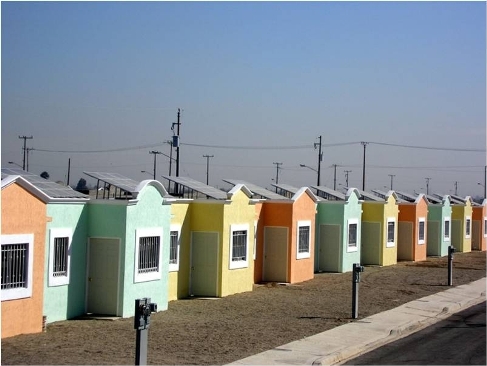
Solar Energy & Energy Efficiency for Baja California Homes


By Keith R | September 9, 2008

This project is interesting to me for several reasons.

I like that it will help home owners reduce their energy consumption, will provide photovoltaics to low- and middle-income households, and will emphasize systems “financially feasible for users” (sometimes household solar systems promoted are not appropriate to the income bracket they are supposed to serve).


I like that the Baja California project is a test case that, if successful, will be duplicated elsewhere in Mexico. [To see why Baja is a good place to start, and where else in Mexico such a project might work well, see my post on LAC solar maps.]

I find it interesting that the project will include work on state-based energy efficiency standards and regulations, something that in the past the Mexican states have left up to the federal authorities. Even more interesting is the reference to setting conditions to attract more renewable energy investments to Baja and the rest of Mexico. I wonder what this will result in? Just favorable conditions on connection and selling to the grid? Or will it also include tax breaks or credits for related equipment, products and services? Stay tuned.

And I’m smiling at the fact that this project is funded by Japanese Trust Fund for Consultancy Services (JCF). My guess is that, because of the source of the funds, the project will have more than Japanese consultants — the products used (photovoltaics, etc.) will likely be sourced from Japan too.

________________________

From the Inter-American Development Bank (IDB):

IDB Supports Renewable Energy and Energy Efficiency for Residential Use in Baja California, Mexico

Pilot project with photovoltaic panels for low- and medium-income sectors

Low- and medium-income households in the Mexican state of Baja California will soon benefit from using photovoltaic panels and other alternative technologies in a pilot project promoting renewable energy and energy efficiency.

This technical cooperation initiative, financed by a US$749,000 donation from the Japanese Trust Fund for Consultancy Services (JCF) at the Inter-American Development Bank, will help selected families in Mexicali—all currently connected to the state’s power grid—reduce their electricity costs.

The financing will support contracting of consulting services and implementation of pilot projects targeting energy efficiency and increased use of alternative energy sources.

Studies will focus on identifying and evaluating projects that are financially feasible for users and can be reproduced in other communities. Another goal will be to establish energy efficiency standards and regulations, as well as conditions for attracting future investments to Baja California and other states in Mexico.

“The idea is to learn from pilot projects on energy efficiency and solar energy resources so that the future will hold more options for supplying sustainable energy at accessible prices,” said IDB project team leader Arnaldo Vieira de Carvalho. “This will also have a positive impact on the environment, because most of the state’s energy currently comes from fossil fuels.”

The project will be executed by the IDB in conjunction with Mexico’s National Energy Savings Commission (CONAE, its initials in Spanish) and the Government of the State of Baja California. It was designed and will be implemented in coordination with the IDB’s Sustainable Energy and Climate Change Initiative (SECCI), whose core objectives are to stimulate greater investments in development of biofuels, renewable energy, energy efficiency, carbon financing and climate change adaptation.

The Japanese Trust Fund for Consultancy Services (JCF) was established by the government of Japan in 1995 and promotes cooperation and knowledge transfer from Japan by utilizing Japanese Consultancy expertise. The JCF has become the largest of the funds established within the technical cooperation funds program managed by the IDB.

________________________

Desde el Banco Interamericano de Desarrollo (BID):

BID apoya Uso Residencial de Energía Renovable y Eficiencia Energética en Baja California, México

Proyecto piloto con paneles fotovoltaicos para sectores de bajos y medianos ingresos

Hogares de medianos y bajos ingresos del estado de Baja California en México se beneficiarán con un proyecto piloto de energía renovable y eficiencia energética, con uso de paneles fotovoltaicos y otras tecnologías alternativas.

La iniciativa de cooperación técnica, financiada con una donación de US$749.000 del Fondo Japonés para Servicios de Consultoría (JCF) en el Banco Interamericano de Desarrollo, ayudará a las familias conectadas a la red eléctrica del estado en Mexicali que sean seleccionadas, a reducir sus gastos de consumo de energía eléctrica.

El financiamiento permitirá la contratación de servicios de consultoría e implementación de proyectos piloto, con el objetivo de aumentar el uso de fuentes alternativas de energía e implementar medidas de eficiencia energética.

Se realizarán estudios destinados a identificar y evaluar proyectos financieramente viables para los usuarios y que puedan reproducirse en otras comunidades. También se buscará establecer normas y regulaciones de eficiencia energética y condiciones para atraer futuras inversiones en Baja California y otros estados mexicanos.

“La idea es aprender de proyectos piloto de eficiencia energética y recursos de energía solar, así en el futuro habrá más opciones disponibles para proporcionar energía sostenible, a precios accesibles para la población,” afirmó el jefe del equipo de proyecto del BID Arnaldo Vieira de Carvalho. “Esto también generará un impacto ambiental positivo, puesto que gran parte de la energía que actualmente se utiliza en el estado proviene del uso de combustibles fósiles.”

El proyecto será ejecutado por el BID con la Comisión Nacional para el Ahorro de Energía – CONAE y el Gobierno del Estado de Baja California. Fue diseñado y será implementado en coordinación con la Iniciativa del BID para Energía Sostenible y Cambio Climático (SECCI, por sus siglas en inglés), que busca estimular mayores inversiones en el desarrollo de biocombustibles, energía renovable, eficiencia energética, financiamiento de carbono y adaptación al cambio climático.

El Fondo Japonés para Servicios de Consultoría (JCF), creado por el gobierno de Japón en 1995, promueve la transferencia de cooperación y conocimiento desde Japón utilizando la experiencia de ese país en el área de consultoría. El JCF se ha convertido en el fondo de mayor tamaño dentro de los programas de fondos de cooperación técnica administrados por el BID.

www.bajainvestment.com

Friday, August 29, 2008

La Playa Motorcross


This NEW track is located just 10 minutes NORTH of downtown Rosarito Beach, Mexico, on the Toll Road K24 on the Hwy.
An incredible OCEAN VIEW track like no other!

Directions to the track:

From San Diego and LA: from Hwy 5 or 805 South, enter Tijuana, Mexico via San Ysidro. Follow the Rosarito-Ensenada TOLL-ROAD, look at the left at K24 on the Hwy (you'll see the track there, continue for about 1/2 mile, make a "U" turn at the RANCHO DEL MAR off ramp, going over the bridge, get on the Highway back to Tijuana, and Slow down for a VERY TECHNICAL exit.
The layout is the classic Outdoors MOTOCROSS Style.

www.bajainvestment.com

The Boys of Winter

Major League Baseball can often be very grueling and get tiresome after a while. Unlike football and basketball, which features a grand total of 98 regular season games combined, pro baseball players must endure through 162 of them. After this season is over, however, some players won't get a chance to catch their breath. Instead of sliding down the slopes of a mountain during their Winter off time, some ballplayers will continue to slide into second base.

Every year, the best athletes with ties to the Greater Antilles participate in a special sporting event known as the Caribbean World Series. It's a big event that attracts thousands of fans, and now for the first time ever scores of Latin athletes will be travelling to Mexicali to showcase their talent.

Political leaders from southern California and southern Arizona are thrilled that the games are going to be played close to home. They're expecting more than 15,000 fans to flock to neighboring cities and are already making the necessary accommodations in anticipation of the big series.

Bob Ingram with the Yuma Visitors Center says he expects about 2,000 rooms to fill up and believes the Desert Southwest's economy will benefit greatly as a result. "I think it'll be very beneficial for restaurants, museums and shopping centers," Ingram said. "It's our opportunity to show off Yuma."

Ingram isn't the only one who thinks that his city will improve economically, city leaders in San Luis and Calexico are projecting big gains as well and, needless to say, they're looking forward to February 2nd when the games officially kick off. In the meantime, however, the waiting game is on as preparations for the big day are still not quite complete.

www.bajainvestment.com

Mexico President Felipe Calderon Dedicates Sempra Energy's New Baja California LNG Terminal

SAN DIEGO, CA, Aug 28, 2008 (MARKET WIRE via COMTEX) -- Mexico President Felipe Calderon, Donald E. Felsinger, chairman and chief executive of Sempra Energy, and other dignitaries were on-hand today to officially dedicate Sempra Energy's (SRE 57.92, -0.66, -1.1%)Energia Costa Azul liquefied natural gas (LNG) receipt terminal in Baja California, Mexico, the first LNG receipt facility on the West Coast of North America.
In operation since May 2008, the $975 million LNG receipt terminal is capable of processing up to 1 billion cubic feet per day of natural gas. At the peak of construction, the project employed more than 3,000 workers.
"Over the past decade Sempra Energy has invested about $2 billion in Mexico's natural gas infrastructure and has worked with elected leaders, regulators and the citizens of Mexico in building new energy infrastructure for the Baja California region," Felsinger said. "We welcome President Calderon to today's historic dedication of Energia Costa Azul and look forward to continued cooperation with Mexico on future energy projects that address the region's needs."
Energia Costa Azul's first cargoes of imported natural gas arrived in April and May 2008.
The LNG receipt terminal is fully contracted. Half of the storage and send-out service has been procured by Shell International Gas Limited under a 20-year agreement. The remaining half of the capacity at Energia Costa Azul will be supplied from a new liquefaction facility BP and its Tangguh LNG Partners are completing in Indonesia. Shipments from BP should begin arriving in the second quarter of 2009.
The natural gas processed at Energia Costa Azul will be used in Baja California and the U.S. Southwest. Natural gas from the terminal will meet applicable Mexico and U.S. gas pipeline quality standards.
LNG is simply natural gas in liquid form. To reach a liquid state, natural gas must be cooled. The liquid gas is then transported aboard specially designed carriers for delivery to receipt terminals. These receipt terminals store LNG, return it to its gaseous state and dispatch it into pipelines for customer use. In LNG's 45-year shipping history, LNG carriers have traveled more than 100 million miles without a major incident.
In addition to the new Energia Costa Azul LNG receipt terminal, Sempra Energy projects in Baja California, Mexico, include: Termoelectrica de Mexicali, a clean, efficient 625-megawatt natural gas fired power plant in Mexicali; natural gas distribution companies in Mexicali, Chihuahua and La Laguna-Durango that serve about 100,000 customers; and natural gas transmission pipelines.
Sempra LNG develops and operates LNG receipt terminals serving North American markets. Sempra Energy, based in San Diego, is a Fortune 500 energy services holding company with 2007 revenues of more than $11 billion. The Sempra Energy companies' 13,500 employees serve more than 29 million consumers worldwide.
Sempra LNG is not the same company as the utility, San Diego Gas & Electric (SDG&E) or Southern California Gas Company (SoCalGas), and is not regulated by the California Public Utilities Commission.
This press release contains statements that are not historical fact and constitute forward-looking statements within the meaning of the Private Securities Litigation Reform Act of 1995. When the company uses words like "believes," "expects," "anticipates," "intends," "plans," "estimates," "may," "would," "could," "should," or similar expressions, or when the company discusses its strategy or plans, the company is making forward-looking statements. Forward-looking statements are not guarantees of performance. They involve risks, uncertainties and assumptions. Future results may differ materially from those expressed in the forward-looking statements. Forward-looking statements are necessarily based upon various assumptions involving judgments with respect to the future and other risks, including, among others: local, regional, national and international economic, competitive, political, legislative and regulatory conditions and developments; actions by the California Public Utilities Commission, California State Legislature, California Department of Water Resources, Federal Energy Regulatory Commission, Federal Reserve Board, U.K. Financial Services Authority and other regulatory bodies in the United States and other countries; capital market conditions, inflation rates, interest rates and exchange rates; energy and trading markets, including the timing and extent of changes in commodity prices; the availability of electric power, natural gas and liquefied natural gas; weather conditions and conservation efforts; war and terrorist attacks; business, regulatory, environmental, and legal decisions and requirements; the status of deregulation of retail natural gas and electricity delivery; the timing and success of business development efforts; the resolution of litigation; and other uncertainties, all of which are difficult to predict and many of which are beyond the control of the company. These risks and uncertainties are further discussed in the company's reports filed with the Securities and Exchange Commission that are available through the EDGAR system without charge at its Web site, www.sec.gov, and on the company's Web site, www.sempra.com.
Media Contact:
Art Larson
Sempra Energy
(877) 866-2066

www.bajainvestment.com

Mexico to build port in Baja to serve U.S.


(08-29) 04:00 PDT Ensenada, Mexico -- President Felipe Calderon opened bidding Thursday for construction of a huge new seaport that could eventually compete with Los Angeles-Long Beach, the largest port complex in the United States.

Mexico's $5 billion Punta Colonet project would transform a wind-swept bay 150 miles south of the U.S. border into a booming port city, creating an estimated 80,000 jobs, drawing freighters from Asia and funneling manufactured goods north.

"We're looking to be sure we don't fall behind in making Mexico a strategic logistics platform for trade and global investment," Calderon said while touring the foggy beach where the port will stand.

A planned railroad would link Punta Colonet to the United States, allowing freight to skip Southern California traffic and head directly to points across the Midwestern United States, including Chicago. Planners have yet to determine where the tracks would cross the border - although El Paso, Texas, and Yuma and Nogales, Ariz., have been mentioned.

The port would be the largest infrastructure project of Calderon's administration, which has pledged hundreds of millions of government dollars for highways, railroads and airports in the last year in an effort to create jobs and pump cash into Mexico, even as the world economy slows.

At Punta Colonet, however, Calderon is seeking private bidders to build the port and accompanying railroad before running it on a 45-year lease.

The bidding should conclude late next year, and the port should start operating in 2012, said Jose Rubio, project director for Mexico's Baja California state, which is working with the federal government to develop the port.

By 2020, the port should be able to annually handle 6 million TEUs, or twenty-foot equivalent units, a measurement used to estimate container traffic - more than double the nation's current freight capacity, Transportation Secretary Luis Tellez said.

Los Angeles and Long Beach processed a combined 15 million TEUs in 2007 - 40 percent of all freight entering the United States, including 80 percent of imports from Asia.

Punta Colonet is one of several competitors to Los Angeles and Long Beach. A massive expansion at Canada's northern Prince Rupert Port will also use rail to move goods to U.S. markets. and a $5 billion expansion of the Panama Canal will make it easier for Asian freight to reach Miami, Atlanta and other southeastern U.S. cities.

www.bajainvestment.com