Thursday, October 9, 2008

Flow to river channel to drop; irrigation uses seen


By Sandra Dibble
UNION-TRIBUNE STAFF WRITER

September 26, 2008

TIJUANA – It sits on a hillside miles from San Diego, rising above tightly packed colonias in Tijuana's fast-growing eastern end. Despite its distance from the border, the new Monte de Los Olivos sewage treatment plant has been drawing applause in California.
Expected to begin operation within a month, the $9 million plant will at full capacity treat the waste of some 265,000 residents to a tertiary level, clean enough for irrigation. Together with a smaller but similar plant, La Morita, set to open this year, Monte de Los Olivos will dramatically decrease the flow of untreated sewage down the Tijuana River channel that leads to the border.

The operation of the two plants also will relieve Tijuana's main sewage treatment plant, the over-burdened Punta Bandera facility south of Playas de Tijuana. By the middle of next year, officials hope the operation of the new plants will largely eliminate the coastal discharges of untreated sewage at Punta Bandera.

“This project puts Baja California at the vanguard of sewage treatment in Mexico,” Baja California Gov. José Guadalupe Osuna Millán told a crowd of more than 300 gathered for yesterday's inauguration ceremony at Monte de los Olivos.

The plant's opening marks the first step in an ambitious state-led reclamation project for Tijuana that will take years to develop. The city's 1.4 million residents look to piped-in water from the Colorado River to meet more than 90 percent of their water needs, and the state has been hard-pressed to expand the region's supply.

By using treated water for irrigation and industry, the state hopes to save the Colorado River water for residential and commercial purposes. But before they can proceed, they need to build a network of pipes to deliver the reclaimed water, and find enough users.

No one disputes that the plants at Monte de los Olivos and La Morita, which will treat sewage in the Tijuana River watershed, represent a major step forward for the city. Financing for the two plants, along with a third scheduled to open next year in southern Tijuana, is through a low-interest loan from the Japanese government and Mexico's federal government. The builder is a Mexico City-based company named Fypasa.

Initially, only 10 percent of Monte de los Olivos' output capacity will be used for reclamation, said Hernando Duran, head of the state public service commission in Tijuana, known as CESPT. The state is setting up a system that will pipe any of the unused treated effluent for discharge into the Pacific Ocean south of Punta Bandera.
“While the system is designed, it's not fully ready,” Romo said. “Overall, it's a very good sign, but people should not expect results by tomorrow.”

Within four years, Duran said the hope is to be using at least three-fourths of Monte de los Olivos' capacity in reclamation projects. Beyond that, the state is also studying the possibility of piping some of the reclaimed water to a point above Tijuana's RodrNguez Dam, allowing it to filter through into the reservoir.

“They deserve a huge amount of credit for what they've done,” said Bart Christensen, senior engineer with California's State Water Resources Control Board, and his agency's border coordinator. “They have the same goals as San Diego, but they don't have the resources San Diego has. They have to be really creative to get their infrastructure implemented in Tijuana. This really demonstrates Mexico's commitment to addressing their own waste water infrastructure needs.”

Despite progress, Tijuana's sewage flow continues to exceed the city's treatment capacity. Cross-border sewage spills have for decades been a contentious issue, as incidents in the Tijuana River basin are likely to be felt across the border in the Tijuana River estuary in Imperial Beach. Though dry weather flows have largely been eliminated, cross-border sewage flows during wet weather continue to shut down South Bay beaches.

Monte de los Olivos “is a critical facility that's necessary to meet Tijuana's waste water treatment needs today and in the future,” said Su Cox, an environmental engineer with the U.S. Environmental Protection Agency, which has been working closely with CESPT on a plan to connect an additional 34,000 residents in eastern Tijuana to the sewer system.

“The thing that's great about this is that it addresses environmental health and public health needs on both sides of the border.”

Highlights
Cost: The $9 million Monte de los Olivos plant will treat sewage from about 265,000 residents in eastern Tijuana.

Irrigation: The plant launches a major reuse project for Tijuana, and officials are installing pipes to distribute the water to green areas. Most of the flow will initially be discharged into the ocean.

Coastal discharge: The plant provides relief for the overburdened coastal Punta Bandera plant. Together with future La Morita plant and new sewage collection projects, the coastal discharge of untreated sewage from the Punta Bandera plant is near an end.

Cross-border: Cross-border sewage flows in wet weather will continue, but the concentration of sewage in those flows is expected to decrease.

Other projects: A third sewage treatment plant in southern Tijuana, a desalination plant in Ensenada that will produce 5.7 million gallons of water a day, and expansion of the Colorado River aqueduct.


www.bajainvestment.com

Mexico emerges as popular property investment for Canadians


Written by Property Wire
Thursday, 02 October 2008
Canadian property investors are increasingly investing in Mexico as they regard the US market as not a good prospect at the moment.
An increase in the number of flights from Canada to Mexico and a desire to avoid the volatility of the US market means more are buying second homes and investment properties further afield.

One investor, Doug Walker, had considered buying in Hawaii and the Caribbean. He wanted a holiday home to which he and his wife could eventually retire. 'We were looking for something special but we also wanted to make a good investment,' he said.

He has now bought a home overlooking the Sea of Cortez and the 18th hole of a private golf club on Mexico's western coast.

Walker is not the only Canadian looking to Mexico for a good investment. According to Alfonso Sumano, the Mexican Tourism Board's regional director for Canada, more and more Canadians are holidaying in Mexico and then deciding to invest.

This year flights arriving in Mexico increased by 9.2% and this has made Mexico an easy destination to reach and boosted interest.

'Canadians can leave home in the morning and be on the beach by lunchtime,' said Sumano. Although he could not provide any official statistics for the number of Canadians buying property in Mexico, he said the number had increased substantially.

At Querencia, the luxury gated community where Walker has invested, about 10% are owned by Canadians. Jorge Carrera, president and chief executive officer of Querencia, said he has seen an increase in interest from Canadians.

'My last five buyers have been Canadians. We haven't really targeted them but with the interest we are getting, we are looking to attract more Canadians,' he added.

He reckons that the strong Canadian dollar, low property taxes – just 0.25% of a property's assessed value – and a very low cost of living make Mexico an attractive location for property investors.

www.bajainvestment.com

Tiger Woods finds a way to keep busy


Since he can't play on a golf course right now, he's trying to design one instead.
Bill Dwyre
October 8, 2008
Tiger Woods had a circular stick in his hand in Southern California again Tuesday and waggled it confidently as he stood over a golf course.

It is not what you think. Tiger is not back, not quite yet.

The knee injury that will be forever etched in our memory as the focal point of his courageous and dramatic playoff victory on that Monday in June at Torrey Pines is still healing. He said his timetable for returning to the PGA Tour is still uncertain. He had surgery shortly after the U.S. Open.

"I can walk, the knee is good, we are right on schedule," he said. "There is no pain, and the work is on strength and mobility."

Well, no pain until the daily rehabilitation begins.

"Oh, man."

He rolled his eyes as he spoke.

"There is lots of work, hours a day. Man."

But it is the very nature of Eldrick Woods to be a tiger about staying busy, even while doctors are keeping him off the golf course. That's why he was here Tuesday. This was Tiger Woods, designer, rather than Tiger Woods, best golfer in the universe.

In a fancy room at a swank hotel -- the room filled with investment, developer and public relations types all dressed elegantly and a scattering of the opposite (also known as the media) -- Woods announced details about his part-time job.

He has designed a golf course on a spectacular piece of land along the Pacific Ocean, just south of Ensenada and about 70 miles south of San Diego. It is called Punta Brava (Wild Point), and is a $100-million project financed by entrepreneur and former NFL and NBA owner Red McCombs.

McCombs, in attendance, said, "When this was brought to me, I wasn't especially turned on. Then, they told me there was a good chance that Tiger would be involved. I said, forget it. It's over. I'm in."

Woods took a display pointer, stood next to an artist's rendering of a proposed Punta Brava, to be completed in about three years, and described something that sounded like it could eventually become the Pebble Beach of Mexico. Pebble Beach of California, of course, is public. Punta Brava will not be.

Woods talked about the elevation on the seven-mile peninsula that dropped from a 1,200-foot mountain to 300-foot ledges for villas and homes that overlook a golf course near sea level. That course, Woods said, will have an ocean view from every tee, fairway and green.

"Now, if you go and hit it in the bushes or the junk," he said, "maybe not."

He said that 12 of the tees or greens are right on the water, that tee shots on eight of the holes will necessitate hitting over water, and No. 18, a Pebble-Beach-like par five dog-legging left with the ocean on the left, may not be as difficult as it looks.

"Some of you will reach it in two," he said, looking away from the media people.

After they had run a video, showing Tiger standing on top of the 1,200-foot mountain and looking out to the ocean, and had finished the description, it was hard not to dash to the sign-up line for a villa. One unconfirmed rumor had several AIG executives, now with more time on their hands than Tiger, set to buy.

Designer Woods said he has purposely gone slowly in this aspect of his career.

"I told myself I would play on every continent before I started designing," he said. "I guess I have missed the Antarctica Four Ball, but otherwise, I've done it.

"I felt I owed that to myself and to the people who will play the courses to have as much experience as I can. I've talked to all the people who have done this. I've learned a lot, thought a lot about it, used the experiences I've had as a player.

"That's why Jack is so successful [at course design]. He was a cerebral player."

Player Woods said the doctors won't let him start swinging the club until January.

"I can't rotate the knee until then," he said, adding that his ideal would be to play one or two events before the Masters in mid-April.

"You just can't tell, once you start back, about things like swelling and soreness," he said. "That can set you back."

Once he gets back, there is little question that we will see more of the same fire and grit he used to fight his way down those Torrey Pines fairways that June Monday afternoon.

"I was supposed to go to Mexico on a site visit for this that day," he said, "But I was busy."

Indeed. Rocco Mediate and millions more remember.

www.bajainvestment.com

Wednesday, October 1, 2008

Mexico Tourism Indicators Up for the First Half of 2008

Posted on September 30, 2008

By: Lisa Coleman

Mexico is a survivor. It seems as much as the U.S. wants to focus on the bad, people still seem to see the good. Despite the steady stream of negative press, the tourists still come, the hotels still thrive, and more and more, people are considering a permanent move south of the border. For those of us who love and understand this amazing country, it’s a constant struggle against the media. They drudge through the daily public drug wars, the poverty, and mold a perception. Still Mexico pushes forward. They are fighting for their image, and for the life blood that is tourism.

It’s no secret things have been rough for Mexico in the last year. The media has made sure you heard it all. Well, I’ve got some good news to share…. people are still coming to Mexico. And the numbers prove the point.

In the first seven months of the year, Mexico received $8.475 million dollars in foreign currency, which signified a 6.3 percent increase compared to the same period in 2007.

• Almost 14 million tourists entered the country, an increase of 5.2 percent compared to the same period last year.
• As of July 2008, the country registered a total of 2.234 million workers in the tourism industry, which represents a 2.3 percent higher rate than the one registered in the same month in 2007.

During the first seven months of the year, there was an influx of $8.475 million dollars from the spending of foreign tourists, which signified a 6.3 percent increase compared to the same period in 2007, informed Rodolfo Elizondo Torres, Secretary of Tourism of Mexico (SECTUR).

According to the most recent data from the Bank of Mexico’s International Visitor Count, Secretary Elizondo said, in the January-July 2008 period, the country received 13.620 million tourists, a quantity that represented a 5.2 percent increase compared to the same period in 2007.

Likewise, the head of SECTUR said that the average spending of tourists who traveled further than the border - those who have the longest stays and greater spending - was of $788 dollars per trip, which represents an increase of 3.8 percent from 2007.

Secretary Elizondo emphasized the airline industry transported 26.5 million passengers between January and July 2008, 6.1 percent more than in 2007.

So there you have it… My sombrero is off to everyone involved with the tourism industry!

www.bajainvestment.com

Saturday, September 20, 2008

Dylan Southworth wins 4th circuit of Las Americas Pro Am

Isaac Avila Cegobiano

Dylan Southworth : photo Isaac Avila Cegobiano

Copas Las Americas Stop #4

Dylan Southworth wins the 4th cup circuit of Las Americas Pro Am > Espanol abajo

Surfersvillage Global Surf News, 19 September, 2008 : - - The local Sayulita Dylan Sourthworth was the fourth stop in Rosarito, BC. Dylan has to be #1 in the Copas Las Americas, now, for sure, he won the Nationals first place in Nexpa as well as in Cabo San Lucas in junior category, he is #2 in the Alas Latin Tour, he ended up #11 in the World Juniors. He only just turned 18 in July.

Sunday 14

With a clear day and a pleasant sun, Playas de Rosarito showed him to surfers with its good climate that we are welcome to this pleasant Mexican Tourist Destination, the waves had dropped slightly but maintained their good form until he reached the wind and conditions varied a bit but that was not an excuse for the surfers who came to compete with everything at stake for $ 81000 pesos to distribute prize.

In this final because they saw the surfers arrived in half an hour that they gave these young surfers staged an electrifying final where more than 800 people who were on the beach appreciated applauding the actions of surfers. The winner of this fourth stop was Dylan who became the first surfer to win two stops of the circuit. Child Congratulations!

WINNERS SHORT BOARD

1. Dylan Southworth $ 30,000 pesos
2. José Manuel Trujillo 20,000 “
3. Abel Estopin 10,000 “
4. Christian Corzo 7,000 “
5. Heriberto Ramirez 5,000 “
6. Raúl Medina 1,000 “
7. Diego Cadena 1,000 ‘
8. Angelo Lozano 1,000 “

BODYBOARDS

This category ran 12 heats before reaching the finals stressing the current National champion Yolanda White, who was the only woman to compete in heats of these men, demonstrating their good level to enter the first heat and move up to the final where they faced Jonatan Lopez, who is her husband and father of the little Helio
At the end came

WINNERS BODYBOARDS

1. Jonatan Lopéz
2. Jonatan Jimenez
3. Jorge Lopéz
4. Yolanda Blanco

www.circuitosurfamericas.com

Espanol

El local de Sayulita Dylan Sourthworth se llevó la cuarta parada en Rosarito, B.C.

Surfersvillage Global Surf News, 19 September, 2008 : - - Gracias al decidido apoyo del Alcalde Municipal de Playas de Rosarito C.P. Hugo Torres Chabert la cuarta parada del circuito de surf copa las americas se llevo a cabo, en donde 32 competidores de tabla corta y tabla de cuerpo libre dierón el show durante dos días de competencías, en esta cuarta parada hubo algunos surfers de California.

Durante el día Viernes se pudo observar a los surfers entrenar en La Playa del muelle, a el torneo llegaron surfers de Oaxaca, Guerrero, Colima, Nayarit, Michoacán, Sinaloa, Baja California Sur y los anfitriones La B.C. afortunadamente para todos Playas de Rosarito le dio una gran bienvenida al circuito y lo recibió con olas de 3-5 pies con buena forma cosa que motivo a los surfers y durante este día Viernes pudimos verlos entrenar sacando aéreos y otras maniobras radicales.

Domingo 14

Con un día despejado y un agradable sol, Playas de Rosarito le mostraba a los surfers con su buen clima que somos bienvenidos a este agradable Destino Turístico Mexicano, las olas habían bajado un poco pero mantenían su buena forma hasta que llegó el viento y las condiciones variaron un poco pero eso no fue excusa para los surfers que entraron con todo a competir ya que estaban en juego $ 81,000 pesos a repartir en premios.

En esta final se pudo observar el porque estos surfers llegaron, en la media hora que se les dio estos jóvenes surfers protagonizaron una final electrizante en donde los mas de 800 gentes que hubo en la playa agradecían aplaudiendo las maniobras de los surfers. El ganador de esta cuarta parada fue Dylan quien se convierte en el primer surfer en ganar dos paradas del Circuito.¡¡¡ Enhorabuena niño!!!!

Tabla de Cuerpo

En esta categoría se corrieron 12 heats antes de llegar a la final destacando la actual campeona Nacional Yolanda Blanco quien fue la única mujer en competir en estos heats de hombres, demostrando su buen nivel al entrar en el primer heat e ir avanzando hasta llegar a la final en donde se enfrentó a Jonatan López quien es su esposo y papá de el pequeño Helio

A la final llegaron Jonatan Jiménez, Yolanda Blanco, Jorge López , Jonatan López. Quedando en primer lugar Jonatan López

Esta cuarta parada se llevo a cabo gracias a nuestros patrocinadores que hicierón posible que este torneo se llevara a cabo X Ayuntamiento de Playas de Rosarito, COTUCO, Quik Silver, Planeta Surf, Monster, Hotel Rosarito Beach, Newsurfersvillage.com.

www.circuitosurfamericas.com
www.bajainvestment.com

Thursday, September 18, 2008

BAJA CALIFORNIA, POTENCIA DE ENERGÍAS RENOVABLES


Inversiones por un monto de 4 mil 900 millones de dólares se esperan recibir a mediano plazo en el corredor Mexicali-Tijuana mediante la ejecución proyectos de energías alternativas, informó el secretario de Desarrollo Económico del Estado, José Posada Gallego. Con lo cual, dijo, Baja California se colocaría como una potencia en la producción de aparatos para generar energías renovables.
El funcionario estatal indicó que la Entidad tiene un crecimiento en demanda energética al año de poco más de 100 megawatts, por lo que se ha fijado como meta obtener 20 por ciento de su energía de fuentes renovables.

En reciente gira de promoción realizada en España, lograron contactar a cinco empresas proveedoras de insumos de la industria de energías alternas. El secretario de la Sedeco dijo que la empresa española Abengoa, la cual aplica soluciones innovadoras para el desarrollo sostenible en los sectores de infraestructura, medio ambiente y energía, expertos en la gestión de agua, anunció la apertura de una oficina en Baja California para Octubre del 2008 en el área de investigación y desarrollo de tecnología de manejo de agua. Por lo que, Posada Gallego aseguró que el Estado sigue siendo muy competitivo en cuanto a la atracción de nuevas inversiones en las áreas de la aeroespacial, aeronáutica, energías renovables, tecnologías de la información y electrónica.

Wednesday, September 10, 2008

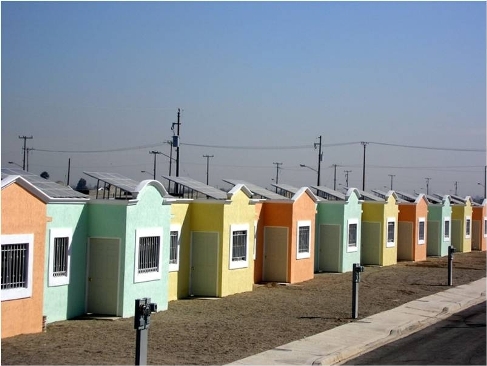
Solar Energy & Energy Efficiency for Baja California Homes


By Keith R | September 9, 2008

This project is interesting to me for several reasons.

I like that it will help home owners reduce their energy consumption, will provide photovoltaics to low- and middle-income households, and will emphasize systems “financially feasible for users” (sometimes household solar systems promoted are not appropriate to the income bracket they are supposed to serve).


I like that the Baja California project is a test case that, if successful, will be duplicated elsewhere in Mexico. [To see why Baja is a good place to start, and where else in Mexico such a project might work well, see my post on LAC solar maps.]

I find it interesting that the project will include work on state-based energy efficiency standards and regulations, something that in the past the Mexican states have left up to the federal authorities. Even more interesting is the reference to setting conditions to attract more renewable energy investments to Baja and the rest of Mexico. I wonder what this will result in? Just favorable conditions on connection and selling to the grid? Or will it also include tax breaks or credits for related equipment, products and services? Stay tuned.

And I’m smiling at the fact that this project is funded by Japanese Trust Fund for Consultancy Services (JCF). My guess is that, because of the source of the funds, the project will have more than Japanese consultants — the products used (photovoltaics, etc.) will likely be sourced from Japan too.

________________________

From the Inter-American Development Bank (IDB):

IDB Supports Renewable Energy and Energy Efficiency for Residential Use in Baja California, Mexico

Pilot project with photovoltaic panels for low- and medium-income sectors

Low- and medium-income households in the Mexican state of Baja California will soon benefit from using photovoltaic panels and other alternative technologies in a pilot project promoting renewable energy and energy efficiency.

This technical cooperation initiative, financed by a US$749,000 donation from the Japanese Trust Fund for Consultancy Services (JCF) at the Inter-American Development Bank, will help selected families in Mexicali—all currently connected to the state’s power grid—reduce their electricity costs.

The financing will support contracting of consulting services and implementation of pilot projects targeting energy efficiency and increased use of alternative energy sources.

Studies will focus on identifying and evaluating projects that are financially feasible for users and can be reproduced in other communities. Another goal will be to establish energy efficiency standards and regulations, as well as conditions for attracting future investments to Baja California and other states in Mexico.

“The idea is to learn from pilot projects on energy efficiency and solar energy resources so that the future will hold more options for supplying sustainable energy at accessible prices,” said IDB project team leader Arnaldo Vieira de Carvalho. “This will also have a positive impact on the environment, because most of the state’s energy currently comes from fossil fuels.”

The project will be executed by the IDB in conjunction with Mexico’s National Energy Savings Commission (CONAE, its initials in Spanish) and the Government of the State of Baja California. It was designed and will be implemented in coordination with the IDB’s Sustainable Energy and Climate Change Initiative (SECCI), whose core objectives are to stimulate greater investments in development of biofuels, renewable energy, energy efficiency, carbon financing and climate change adaptation.

The Japanese Trust Fund for Consultancy Services (JCF) was established by the government of Japan in 1995 and promotes cooperation and knowledge transfer from Japan by utilizing Japanese Consultancy expertise. The JCF has become the largest of the funds established within the technical cooperation funds program managed by the IDB.

________________________

Desde el Banco Interamericano de Desarrollo (BID):

BID apoya Uso Residencial de Energía Renovable y Eficiencia Energética en Baja California, México

Proyecto piloto con paneles fotovoltaicos para sectores de bajos y medianos ingresos

Hogares de medianos y bajos ingresos del estado de Baja California en México se beneficiarán con un proyecto piloto de energía renovable y eficiencia energética, con uso de paneles fotovoltaicos y otras tecnologías alternativas.

La iniciativa de cooperación técnica, financiada con una donación de US$749.000 del Fondo Japonés para Servicios de Consultoría (JCF) en el Banco Interamericano de Desarrollo, ayudará a las familias conectadas a la red eléctrica del estado en Mexicali que sean seleccionadas, a reducir sus gastos de consumo de energía eléctrica.

El financiamiento permitirá la contratación de servicios de consultoría e implementación de proyectos piloto, con el objetivo de aumentar el uso de fuentes alternativas de energía e implementar medidas de eficiencia energética.

Se realizarán estudios destinados a identificar y evaluar proyectos financieramente viables para los usuarios y que puedan reproducirse en otras comunidades. También se buscará establecer normas y regulaciones de eficiencia energética y condiciones para atraer futuras inversiones en Baja California y otros estados mexicanos.

“La idea es aprender de proyectos piloto de eficiencia energética y recursos de energía solar, así en el futuro habrá más opciones disponibles para proporcionar energía sostenible, a precios accesibles para la población,” afirmó el jefe del equipo de proyecto del BID Arnaldo Vieira de Carvalho. “Esto también generará un impacto ambiental positivo, puesto que gran parte de la energía que actualmente se utiliza en el estado proviene del uso de combustibles fósiles.”

El proyecto será ejecutado por el BID con la Comisión Nacional para el Ahorro de Energía – CONAE y el Gobierno del Estado de Baja California. Fue diseñado y será implementado en coordinación con la Iniciativa del BID para Energía Sostenible y Cambio Climático (SECCI, por sus siglas en inglés), que busca estimular mayores inversiones en el desarrollo de biocombustibles, energía renovable, eficiencia energética, financiamiento de carbono y adaptación al cambio climático.

El Fondo Japonés para Servicios de Consultoría (JCF), creado por el gobierno de Japón en 1995, promueve la transferencia de cooperación y conocimiento desde Japón utilizando la experiencia de ese país en el área de consultoría. El JCF se ha convertido en el fondo de mayor tamaño dentro de los programas de fondos de cooperación técnica administrados por el BID.

www.bajainvestment.com